

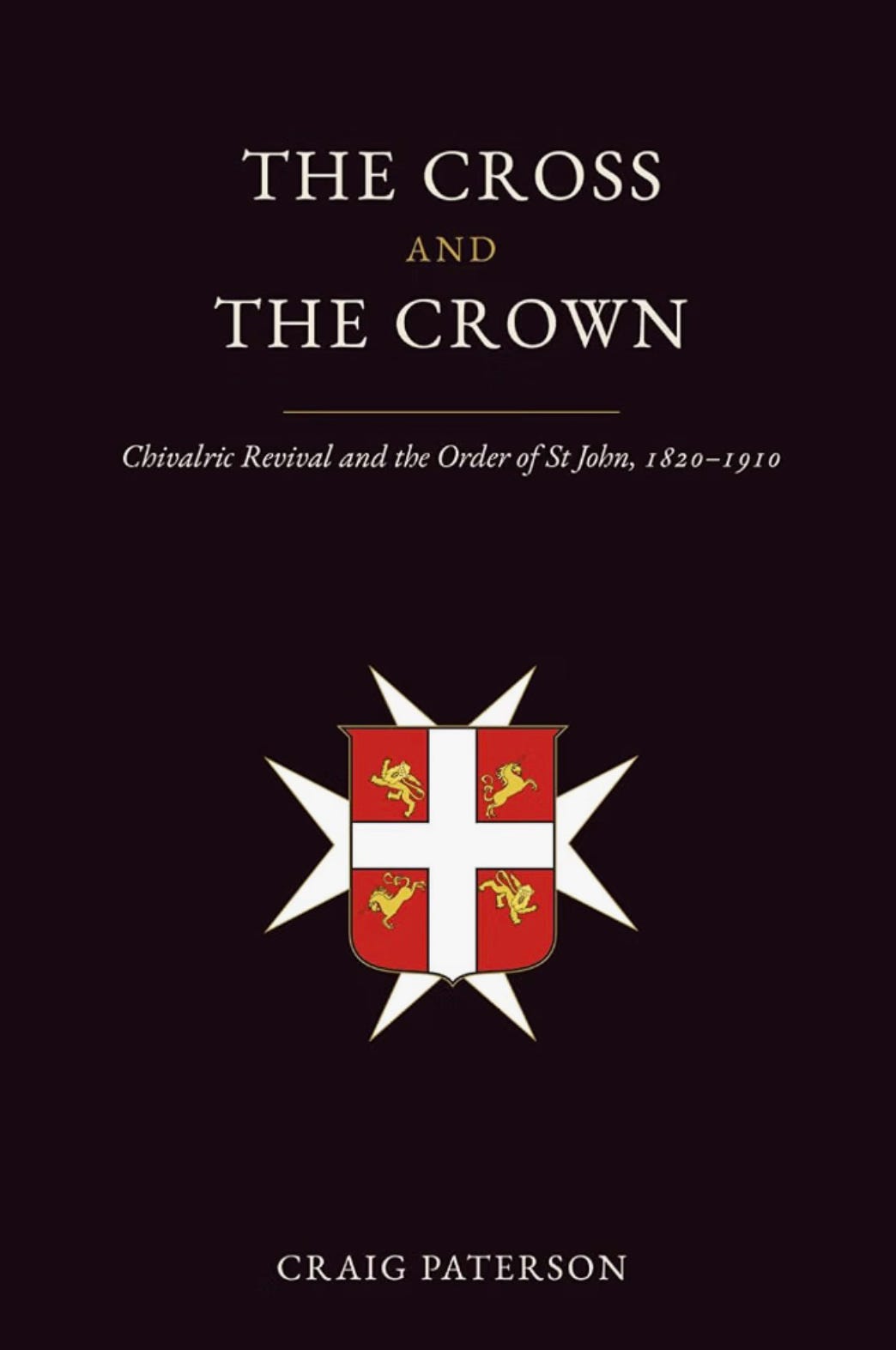
Craig Paterson, The Cross and the Crown: Chivalric Revival and the Order of St John, 1820–1910. Pro Fide Press, 2026. Hardback (ISBN 979-8-234-27699-5) and paperback (ISBN 979-8-234-27723-7).
. . .
. . .
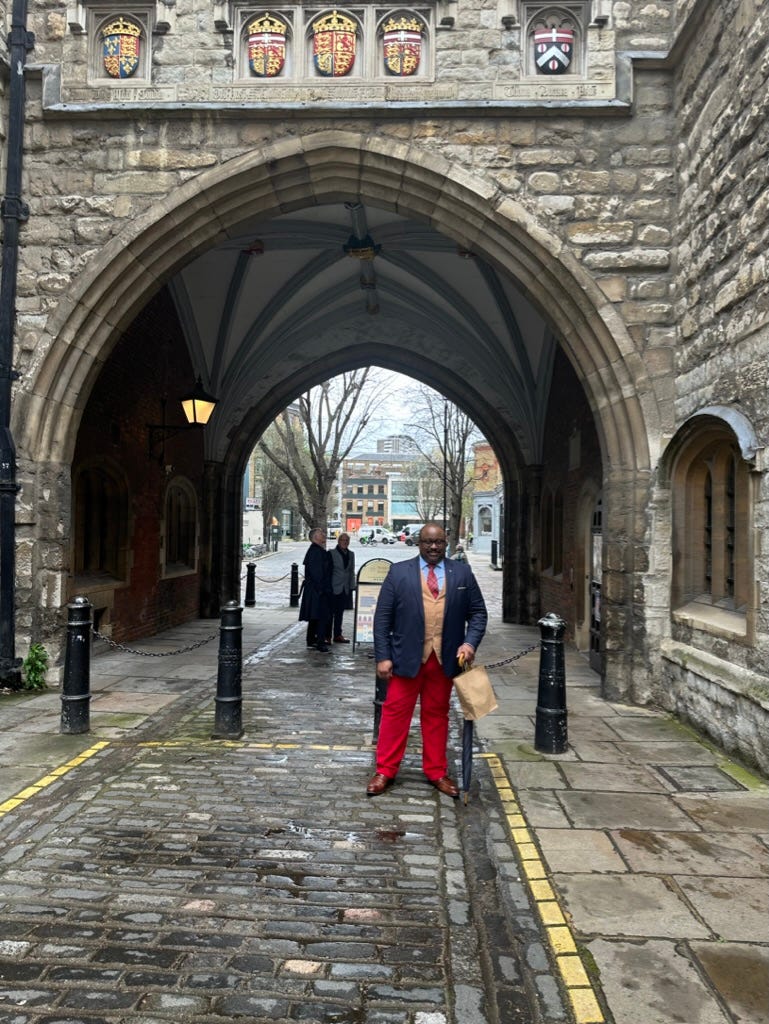
I have stood in St John’s Lane in Clerkenwell and beheld the old gatehouse of the Hospitallers’ priory rising before me, its Tudor stone darkened by five centuries of London weather and its rooms given over now to the museum of the revived Order. Most people know that Order by its ambulances and its eye hospitals and clinics in the Holy Land, yet far fewer have paused to ask how a Protestant British order of chivalry, incorporated by royal charter in 1888, came to wear the eight-pointed cross of the medieval Knights Hospitaller and to call itself their heir. Craig Paterson has made that question his subject, and he answers it with his customary thoroughness and a quiet wit. Across seventeen chapters in four parts, he follows the revival from the speculative schemes of the 1820s and 1830s to the close of the Edwardian age, asking at every stage what the revived body claimed to be and on whose authority.
. . .
. . .
Before I begin this review in earnest, I must declare an interest, or rather two. Craig is a dear friend of several years, and the cross in question is one that I wear myself as both a member of the Order of St John and a Provisional Knight of the Sovereign Military Order of Malta. That places me, somewhat unusually, on both sides of the question Paterson examines, and readers are entitled to weigh my enthusiasm accordingly.
. . .
The opening chapters, devoted to the men who set the whole enterprise in motion, read at moments like a detective story, and Paterson does not spare his suspects. Chief among them stands Sir Richard Broun, Grand Secretary and Registrar of the English langue and a pamphleteer of inexhaustible industry, whose knighthood was self-assumed and whose family’s claim to a baronetcy was later doubted in print. Paterson lays out the evidence with a prosecutor’s patience, drawing chiefly on Pixley’s History of the Baronetage. He is no less scrupulous with Sir William Hillary’s scheme for the Holy Land, and with the rebuff of 1842, when Frederick William IV of Prussia turned the English langue’s scheme aside, taking offence at a reference in its address to the Order’s sovereignty. For that episode he relies upon Elizabeth Siberry’s reading of the Order’s minute books and, to his credit, says so plainly.
. . .
Most consequential of all, and most likely to unsettle members of the Order, is what Paterson found when he tested the claim of continuity. Later official histories describe the Order as the revived “sixth or English langue” of the Hospitallers, yet when he returned to the printed Charter and Statutes of 1888, he found that Statute 1 says only that the Grand Priory of England shall be the head of the Order in England. The words “sixth”, “langue”, and “Venerable” appear nowhere in the charter, in the statutes, or in the regulations bound with them. Nor does Edwin King’s history of 1934 employ the “sixth or English” formula, which leads Paterson to conclude that it crept into the official histories sometime between King and Sir Harry Luke’s revision of 1967. King’s own volume, moreover, prints the early Grand Priors beneath a heading recording that they were not recognised by the Grand Master, and Paterson rightly reads this as the Order testifying, in its own hand, against its grander claim.
. . .
. . .
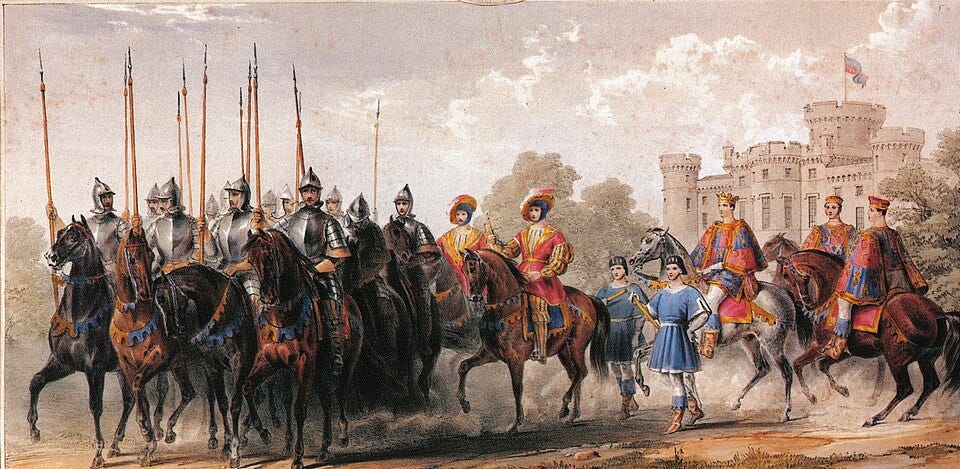
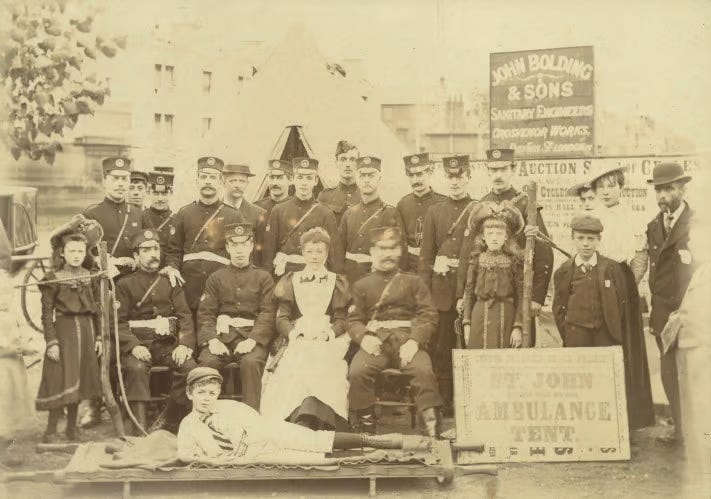
From the founders, the book turns to the Order’s slow metamorphosis from a romantic society into a working charity, and Paterson handles the transformation with considerable finesse. He binds the revival to the Victorian appetite for chivalry through Colonel Sir Charles Lamb, Knight Marshal of the Lists at the Eglinton tournament of 1839 (that splendid folly which the Ayrshire rain reduced to a sodden pageant) and Prior from 1847. He reads Kenelm Digby’s Broad Stone of Honour with unusual care, correcting along the way a reading of it in David Cannadine’s work, before turning to the men who made the Order useful: John Furley, Sir Edmund Lechmere, and Colonel Sir Herbert Perrott, who served as Chief Secretary of the St John Ambulance Association for more than forty years from its formation in 1877.
. . .
Having spent a good many years teaching first aid and emergency medical response to laymen, I confess these pages moved me more than I expected. The conviction that an ordinary person, properly taught, can keep a stranger alive until specialist help arrives seems so self-evident today that one forgets it once had to be championed, and by men very like these. The book’s method shows to particular advantage in recovering the deeds of two such ordinary men. Working from the Order’s own printed roll, Paterson recovers the Life Saving Medal awards of 1875, made to Hallam and Vickers for the rescue of six workmen in a coal-pit shaft near Chesterfield.
. . .
. . .
The final part takes up the charter of 1888 and all that flowed from it: the statutes, the grades, the badges, and the reservation of the Imperial Crown on the badge to the Grand Prior and the Princess of Wales. Its closing chapter, “By Grant and Not by Pretence”, gathers the argument that everything before it has patiently prepared. The Order’s standing rests on the Crown’s grant of 1888, and it has no need to borrow dignity from a medieval descent it cannot actually prove. Paterson takes care that none of this should read as debunking. What emerges instead is an institution secure in its charter and in its works.
. . .
The scholarship is formidable, yet the book is never hard going. More than five hundred footnotes undergird the text, and a full bibliography is matched by an excellent index. Paterson adopts the first person when weighing evidence yet otherwise stands discreetly aside, writing with a lucidity and evident affection for his subject that keep even the most detailed passages readable. His portraits of the founders and early officers, Broun above all, are drawn with a novelist’s eye for vanity.
. . .
. . .
The Cross and the Crown is a fine account of how the Order of St John came into being in its modern form, and I commend it heartily. Historians of Victorian philanthropy and of the nineteenth-century medieval revival will find much to use in it, as will students of honours and heraldry, though its most grateful readers will surely be members of the Order who wish to know where their institution truly came from. It is, moreover, a book that does some measure of good in the world, for all profits from its sale are to be donated to the St John of Jerusalem Eye Hospital Group, whose hospital in Jerusalem is the nearest the modern Order comes to the one its medieval namesakes once kept in the same city.
. . .
where to purchase
• Amazon
. . .