

a brief note on publication
Friends, despite a brief interruption, the serialisation of Sinfonia Apologia resumes with the third instalment: movement iv, ‘kinship’.
If you are joining us only now, welcome. Here follows a brief note to orient you. As a whole, this essay runs to some twenty-five thousand words, essentially half a novel in length, arranged as eight movements bookended by a prologue and an epilogue. I am publishing it as a serial precisely because so much of what it asks of a reader deserves to be sat with rather than consumed in a single sitting. The prologue & first movement were published on 14 August; I would ask you, before proceeding here, to begin there, instead. As with a symphony, this really only makes sense upon hearing the first notes.
For those of you returning, thank you for accompanying me on this journey and for whatever quiet reflection you have already given these words so far. What follows now takes up where we left off.
The serial continues through this weekend and will conclude over the next week. Please, as before, read each portion as it comes, and allow it settle before the next one arrives.
Welcome back, friend. It’s good to have you here.
-Anthony McAlister
28 August 2026
. . .
movements
prologue
i. the pretzel
ii. on the plantation
iii. inheritance
iv. kinship
v. on sovereignty
vi. roots
vii. the argument
viii. reckoning
epilogue
. . .
iv. kinship
. . .
I was in high school when I first encountered the work of Joseph de Maistre, the Savoyard philosopher and diplomat whose writings form, alongside Edmund Burke’s, the foundational texts and intellectual moorings of traditional conservative belief. I cannot now recall precisely how he came to me, whether through a teacher, a library shelf, the ramblings of one of my preternaturally learned friends, or one of those providential accidents of reading that shape a life without announcing themselves at the time. What I do recall is the effect. Here was a mind that refused, with a rigour by which my attention was immediately arrested, the central assumption of the so-called Enlightenment: that human reason, properly applied, is capable of constructing a just and stable social order from first principles. De Maistre regarded this assumption as considerably worse than mistaken, an outsized and misplaced form of intellectual hauteur, dangerous precisely because it flattered its own confidence, that, when translated into political and social action, had produced, was producing, and would continue to produce unmitigated catastrophe. He had watched, with horror, the French Revolution devour its own children. He had seen what happened when men decided that the accumulated wisdom of centuries, embodied in institutions, traditions, the academy, and the authority of the Church, was mere superstition to be swept aside in favour of abstract rational schemes. He was in no way surprised by The Terror. He had seen it creeping near from the very beginning. For de Maistre and his ilk, Liberté, Égalité, Fraternité was a disingenuous, cynical, and ultimately dangerous rallying cry deployed to give cover to man’s ultra vires usurpation of legitimate sovereignty, by any means necessary and at any cost.
. . .
What de Maistre offered in place of Enlightenment rationalism was something at once more humble and more profound than mere obscurantism or reaction for its own sake. Truth, he insisted, is received rather than constructed: through revelation, through the living witness of historical experience, and through the accumulated moral knowledge of a civilisation that has learned, at considerable cost, what human nature actually is rather than what we might wish it to be. Organic institutions, he argued, those that have developed slowly over time and adapted to the realities of human life, are always to be preferred to written constitutions imposed from above, however elegantly reasoned and wrought. The natural law, which he understood as the innate moral architecture of very creation itself, cannot be repealed by legislative fiat or revolutionary rumbling – only violated, and the violation always exacts a price.
. . .
Edmund Burke, for whose writings and philosophy de Maistre functioned for me as a kind of gateway drug, understood this as well, and presented it with a beauty that de Maistre, for all his fire, never quite managed to achieve. It was Burke who gave me what I have come to regard as the most complete and most honest understanding of what human society actually is: a sacred covenant, he wrote, not merely between those who are living, but between those who are living, those who have gone before, and those who are yet to be. This simple, yet achingly beautiful sentiment I genuinely regard as one of the most radical and most necessary ideas in the history of political thought. It compels us, in all our sophistication and knowledge and, yes, enlightenment, to consider and, indeed, accept that we are not the authors of the world we inhabit. We are its stewards, temporary custodians of some precious thing inherited from people we have never met and yet are obligated to pass on, intact or improved, to people who do not yet exist. Our debts run in both directions. We owe unto the dead the respect of not casually dismissing and cruelly discarding what they built at such terrible cost. We owe unto the unborn the decency of refraining from pulling down the walls and leaving to them the detritus and debris.
. . .


. . .
This understanding of society as a partnership existing across the whole of time lies at the very heart of everything I have come to believe about institutions, about tradition, about the family, and about the proper limits of any one generation’s authority to remake the world according to its own often myopic and shallow preferences. It is why I loathe revolution, all revolution, in both principle and practice – not merely those of France, but the permanent revolution that the progressive Left have been steadily fomenting within Western societies for the better part of a century. Revolutions, by their nature, require the destruction of existing institutions as a precondition and metric of success. They must delegitimise what is before they are free to impose what they deem ought to be, in their estimation. According to their lights. On the basis of their reason. And they always, with a regularity that history has now rendered axiomatic, produce something worse than what they replaced. The wolf who comes after the shepherd is invariably hungrier than the one who came before.
. . .
Clemens von Metternich, whom history has treated more harshly than is merited, understood the inherent value of the balance of power as a conservative achievement in its own right, the assertion that no single nation or ideology should be permitted to dominate the European order of the day, because the ambition to dominate always ends in the attempt to transform, and the attempt to transform has a penchant for slouching towards violence. Juan Donoso Cortés, far less known than he ought to be, saw in the revolutionary movements of his own century the outlines of something he could only describe in theological terms: the will to remake human nature itself, to produce by political means the perfection that Christian theology and anthropology place solely in the life to come. These were the minds that slowly, yet irretrievably, shaped my understanding of what conservatism actually is. In time, I came to understand it as the political disposition most naturally aligned with mankind’s intrinsic worth, and the one most capable of sustaining what actually builds and preserves a civilisation.
. . .
Thus, the unearned caricature of conservatism as a soulless defence of privilege, a mechanism of oppression and injustice, or a nostalgia for some imagined golden age gone by was, for me, dismantled by these dead European men and replaced with something far sturdier: an honest recognition that human beings are fallen creatures. Our best institutions were never built by grand design; they were built by the slow, painful, costly accumulation of experience and wisdom, and to discard such precious inheritances in the name of so-called progress is not liberation. It is suicidal amnesia.
. . .


. . .
Yet, philosophy of this kind, however provocative and bracing, risks remaining rather an abstract thing confined to the eighteenth and nineteenth centuries, a museum of dead European men, all admired from a comfortable distance. What made it live and rich and tangible for me, what turned inheritance into instinct, was the close examination of the lives of four extraordinary people considerably closer to my own century, none of them philosophers by trade, each of them proof that the thing de Maistre and Burke had described in the abstract was still, in living memory, being lived out by particular men and women against particular and often vicious resistance.
. . .
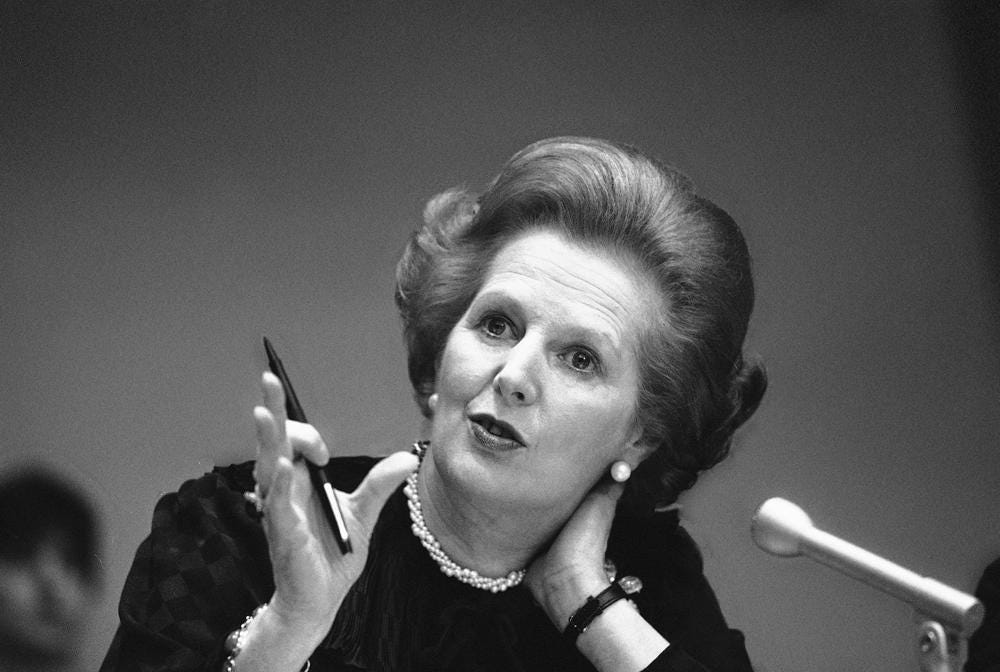
I was eight years old in 1990, when Margaret Thatcher was treacherously edged out of 10 Downing Street, much too young to have any real sense of who and what she was, let alone any opinion of her at all. My first substantive encounter with her came years later, at a high school lunch table full of fellow magnet school classmates considerably more precocious and reliably vociferous than I was. Alas, memory will not reveal to me the precise prompt that compelled a brilliant yet utterly unpersuadable friend of mine to launch into a passionate indictment of the Iron Lady’s legacy: the Falklands, the miners, the stratification of British society for which blame was readily thrown at her feet. I listened, and while listening noticed something: everyone at that table with a strong opinion of Mrs. Thatcher had inherited it, the way I had once inherited my own vague political identity, from atmosphere rather than investigation. So, I did the very thing I was soon to do again in my investigations of Catholic doctrine, and would do once more, decades on, when honestly grappling with my own country’s politics. I went looking for her in her own words rather than the oft-malign verdicts of her critics, and found her, of all places, in Hansard, and proceeded to read her speeches free from the imposition of anyone’s external interpretive scaffolding. I soon found myself, and have remained to this day, tremendously impressed. Thatcher came from a solidly middle-class family in a country and at a time when that meant something rather more constraining than it does here and now. Yet, in the face of those constraints, she rose, entirely on the strength of her own conviction and by the force of her own considerable will, to become the longest continuously serving British Prime Minister of the twentieth century, and, I would argue, the greatest since Churchill. Her core conviction, that human beings, left free of undue interference and meretricious attempts at social engineering, have room in which to accomplish extraordinary things, animated every position she held. I think it not a coincidence that the fiercest opposition she faced regarded her conservatism itself as the disqualifying fact, in precisely the way I would later observe on this side of The Pond with Janice Rogers Brown. Margaret Thatcher was, by even the most niggardly of accounting, a woman of genuine historic firsts. That her critics so rarely lead with this, and instead so consistently present her as Scrooge in a smock, tells you a great deal about which of the two facts actually offends them.
. . .
. . .
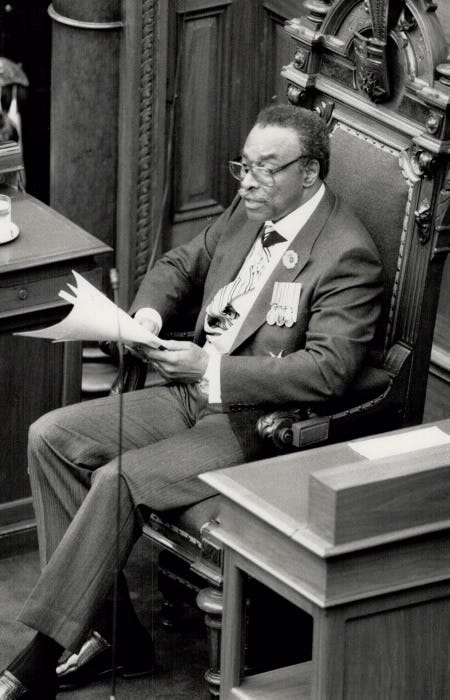
Margaret Thatcher was indeed a conservative heroine of mine, and yet my affinity for her, particularly in those early years, was constrained somewhat by the feeling I could not fully identify with her. Happening upon the extraordinary life and accomplishments of Lincoln MacCauley Alexander, however, provided me a more immediately tangible conservative role model whose background I, at least in part, felt I shared. Alexander, whom precious few American readers will likely have heard of, made perhaps the deepest impression on me of all four, in large part because his story belongs to no American mythology I had been spoon-fed and digested. Born in Toronto to West Indian immigrant parents – his father a master carpenter in his homeland yet permitted only to work as a railway porter in his adopted land, his mother a tender, devout, longsuffering housemaid – Alexander grew up within a rigid Canadian racial stratification most Americans are shocked to learn their northern neighbour ever employed. He served in the Royal Canadian Air Force during the Second World War, enlisting the same year the service’s race restrictions were finally dropped, one of a documented handful of Black Canadians to do so. He became, in turn, the first Black member of the Canadian House of Commons, the first Black federal cabinet minister, and the first Black person to hold vice-regal office in Canada as a Lieutenant Governor, Her Majesty Queen Elizabeth II’s official representative in the Province of Ontario.1 None of this came easily, none of it came early. Upon graduating from law school, no law firm in Ontario would hire him, not for any deficiency of talent or intellectual prowess but for the plain fact of his race; yet rather than wait for permission that was never going to come, he opened his own practice and built it into a powerhouse. He joined the Progressive Conservative Party at a moment when it held considerably little appeal or representation for Black Canadians, not despite that fact but because of it, choosing to reform an institution from within rather than accept exclusion from it or worse, abandon it to its baser instincts. His own coat of arms, granted comparatively late in his life, bears the motto Confidence, Determination, Perseverance: three words that, knowing the man and his story, strike me as less a slogan than an honest description. I never had the chance to meet Lincoln Alexander, and yet I owe him more than I owe most people I have.
. . .
. . .

. . .
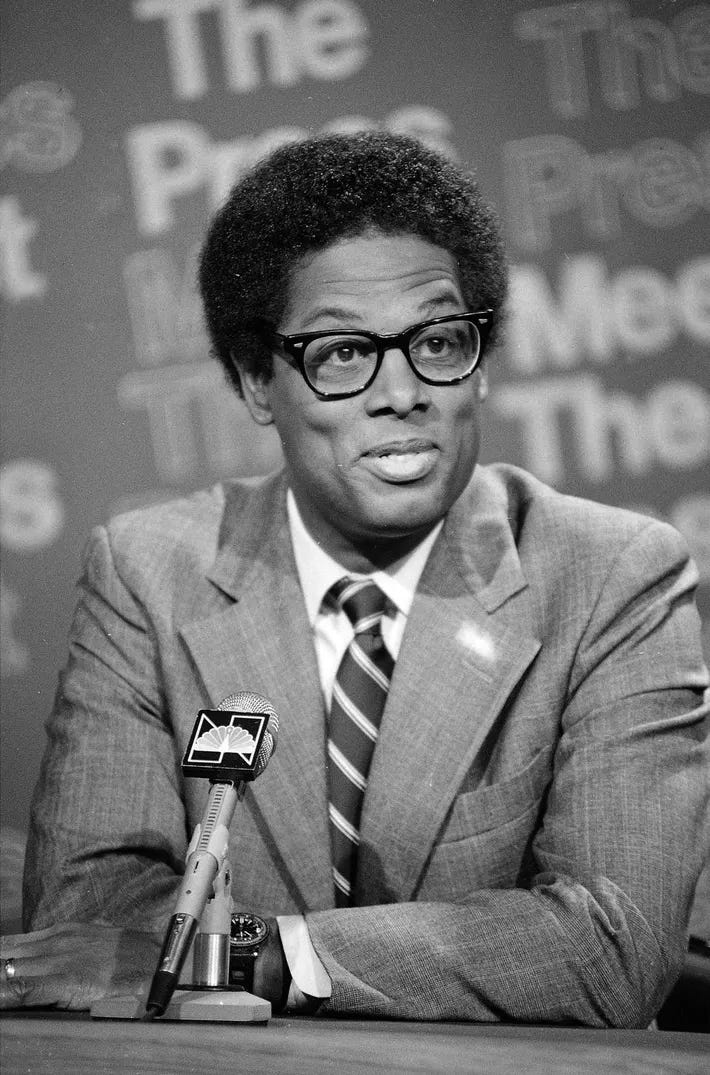
If it was some measure of comfort or solidarity I was unconsciously seeking in casting about for conservative leaders who reflected both my ethnicity and class, it would not be long before I discovered, to my delight, that, while not quite a pantheon, there did indeed exist, and to a considerable degree is extant, a truly laudable roster of men and women of colour for whom mere colour is in no way the determinant of their beliefs. Encountering Dr. Thomas Sowell, who, thank God, though well into his 90s is still with us, gave an intellectual architecture to things I had already begun, however haltingly, to suspect were true. My barrister bookcase proudly boasts an entire shelf of his works, each one greedily devoured and each one, in its way, a miniature graduate seminar in intellectual honesty. Sowell was raised in near-crushing poverty in North Carolina in the early part of the 1930s and then in Harlem after his family relocated, lost both parents while young, and was forced to withdraw from high school before graduating in order to work, eventually completing his diploma via night school, a setback that would likely have imploded most people’s ambitions yet merely rerouted his. He was, for the whole of his young adulthood, an avowed and serious Marxist, and I think this is important to pause and reflect upon because his eventual conversion from that sinister ideology is, I think, the single most remarkable and methodologically important story among these four profiles in courage. In the summer of 1960, whilst working as an intern at the U.S. Department of Labor, Sowell was assigned to study the effects of minimum wage laws on employment within Puerto Rico’s sugar industry, and found, to his own evident discomfort, that the law was measurably increasing unemployment among the very workers it was meant to protect.2 It was not a lecture that moved him, but the data itself, examined honestly and followed wherever it led, regardless of what he had previously believed or wished to be true. That discipline, to trust the evidence over the ideology, to trust the outcome over the stated intention, has defined the whole of his subsequent career, and I do not think it is an overstatement to say it is the single method I have tried hardest to make my own throughout every paragraph of this essay, including those that proved the most difficult to write honestly.
. . .
. . .
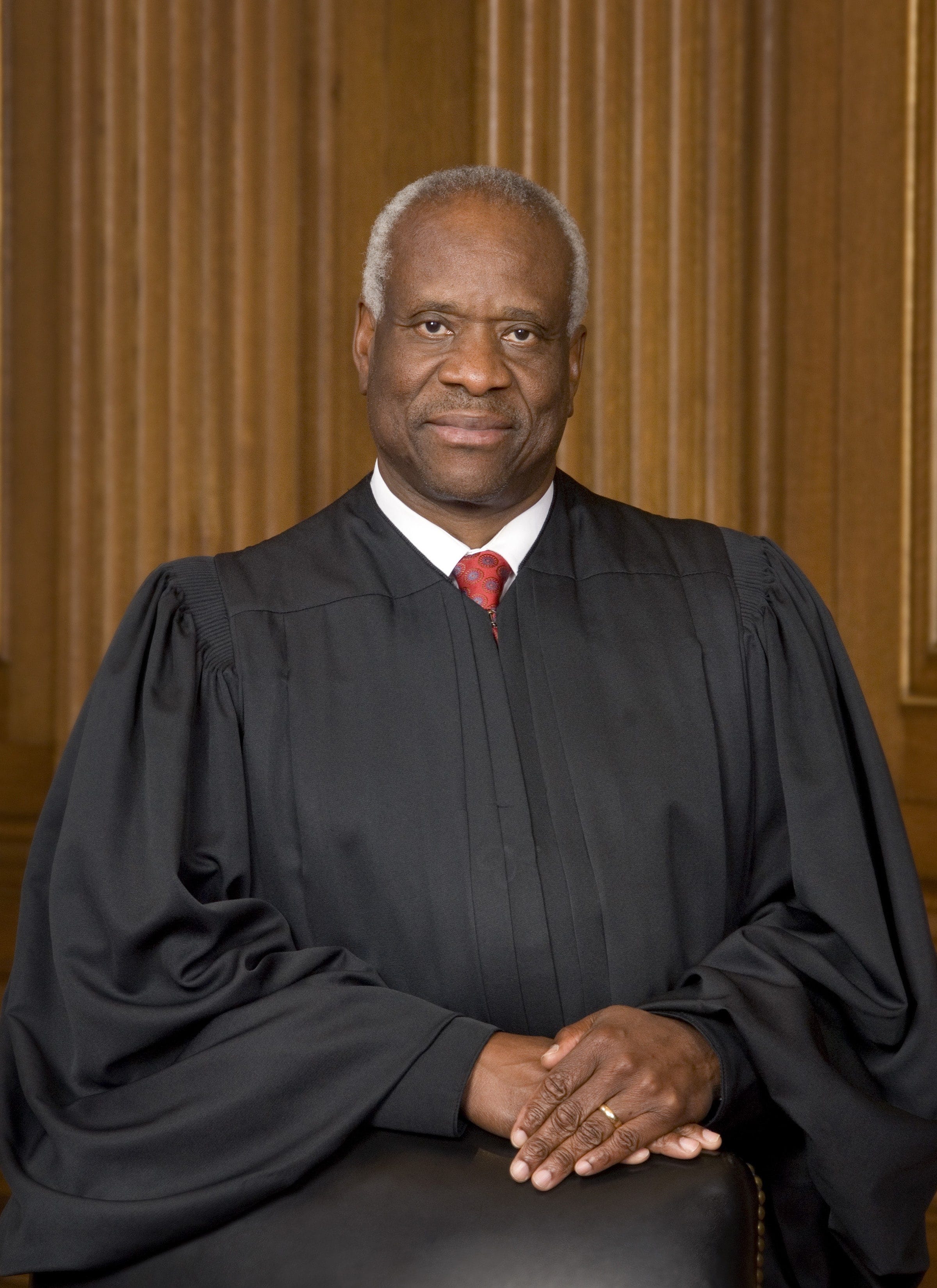
Clarence Thomas rounds out this quartet of latter-day conservative worthies, and I have rather a good hunch his inclusion here will unnerve certain readers far more than anything else in this movement, which I confess does not trouble me in the slightest for reasons you will hopefully soon understand. Thomas was born in Pin Point, Georgia, a small Gullah-Geechee community founded by Freedmen. To the surprise of most, he did not grow up with English as his first language; he spoke Gullah, sometimes called Geechee, an English-based Creole particular to the Sea Islands, until he was well into childhood.3 He was raised largely by his grandfather after the age of six, educated in various Catholic schools, and was, from that same Catholic formation, never a convert but a cradle believer, carrying his faith the way he has carried everything else in his public life, without apology and without display, refusing either to hide it or to perform it for an audience that would prefer one or the other. He graduated from Yale Law School in 1974, one of roughly ten Black students in a class of one hundred and sixty. Yet the achievement curdled almost immediately, as recounted in his memoir: hiring interviewers in his third year asked, in his words, pointed questions unsubtly suggesting that they doubted he was as smart as his grades indicated, forcing him to conclude bitterly that a law degree from Yale bore, for a Black graduate, the taint of racial preference regardless of the work that had actually earned it.4 He has kept, ever since, a fifteen-cent price sticker from a cigar wrapper affixed to the diploma’s frame, stored in his basement rather than displayed; forever a reminder, in his own telling, of the degree’s diminished worth in the eyes of the men who might have hired him.
. . .
. . .
President George H. W. Bush in 1991 nominated Thomas to the U.S. Supreme Court. He was ultimately confirmed that same year, but only after being subjected to a confirmation process of a viciousness that had, until that point, no real precedent in American public life.5 He was offered, more than once, the chance to quietly withdraw rather than endure what was to follow, yet he refused, electing instead to decry the proceedings, in words that have outlived the men who orchestrated them, a “high-tech lynching”. I do not believe he was wrong.
. . .
Presently, he has sat on the Court longer than any of his colleagues. Yet, despite this remarkable tenure, he has regularly been purposefully maligned by those on the left as intellectually incurious for the simple reason that he famously declined, for many years, to engage in performative enquiry for the benefit of media microphones during oral arguments by questioning the lawyers appearing before the Court, preferring instead to closely evaluate the substance of the arguments presented in lawyers’ written briefs. And yet, he remains, by any objective reading of his jurisprudence rather than his caricature, one of the most prolific and consequential legal minds of his generation. He is, I think, living proof of a point I have strained to make throughout this essay and will argue yet again before it ends: that the fury a Black conservative elicits from a certain class of so-called Progressive is rarely about the substance of his positions and almost never about his competence. It is about the very fact of him. It is about what his mere existence, unbothered and unrepentant, implies about everyone who insisted he could not exist at all.
. . .

. . .
I shall pause here, ever so briefly, as this movement has now twice raised a subject without engaging it directly, and because I think the distinction matters enormously. There is a considerable difference between the desegregation of an unjustly racially stratified or exclusionary institution and what came to be called, a generation later, affirmative action, and I think the collapsing of the two into a single undifferentiated category under the loose classification of civil rights has done actual damage to the clarity with which this country is able to discuss either of them. The Los Angeles Fire Department, to take an example close to my own experience, maintained racial segregation as policy until the mid-1950s. Black firemen were prohibited from serving alongside White firemen and, in fact, were only permitted to be stationed at just two Black-only firehouses. This strict separation therefore meant that, either by design or inevitable happenstance, Black firemen, regardless of their courage or competence, were denied the same opportunity to rise in rank as enjoyed by White firemen. The organisations that eventually fought back against that ghastly status quo, and won, were not asking for the bar to be lowered. They were asking for the same bar, applied to men who had already cleared every test the department administered and had been told, regardless, that the uniform itself was not for them. That is a documented historical wrong, remedied by documented historical struggle, and I honour the memory of that struggle.
. . .
Affirmative action, as I observed it and as I came to oppose it at age fifteen, is a wholly different act, and the difference is not a matter of degree but of kind. It does not ask that a closed door be opened. It presumes the door is already open, and then alters, by administrative or legislative fiat rather than by the individual’s own effort, the terms on which the competition behind that open door is judged, on the theory that the individual cannot be sufficiently relied upon to clear the existing bar without some quiet adjustment being made on his behalf. I have looked and have yet to locate the compassion within that theory. I have only ever been able to discern the condescension, the paternalism that the second movement of this essay has already laid out at length, applied here not by a stranger in an anonymous comment section, but by an institution that believed itself to be helping. Mr Justice Thomas’ fifteen-cent sticker is what that condescension looks like when it has had four decades to compound. I recognise the shape of the isolation that produced it, having met my own version of the same at fifteen, cut off at an instant from people who had called themselves my own for daring to refuse the part I had been assigned to play. Neither of us was accused of the same thing. Yet, both of us learned, at the moment it mattered most, exactly how lonely that refusal could leave a man.
. . .
Let us leave the argument where it lies for a moment, because I think it belongs there, and turn our attention to a similarly problematic episode that occurred only this summer.
. . .
In July of this year, the prestigious one-hundred-and-twenty-two-year-old Stuyvesant High School in New York City, among the most academically demanding public schools in the country, released the racial breakdown of its incoming class of freshmen. Of seven hundred and seventy-seven offers, three went to Black students.6 The breathless reportage and outraged commentary that followed arrived exactly on schedule, from exactly the two directions one might have predicted: some read the number as self-evident proof that the admissions process itself must be broken, requiring intervention; others read it as self-evident proof of something considerably more sinister, an innate ceiling on what Black students could be expected to achieve at the advanced end of the academic pool. I confess I find both assessments much too easy, and I’ll tell you why: because I think the actual data, rather than either faction’s distillation of it, relates a more difficult and more honest story than either was willing to broach.
. . .

. . .
Black students were not, as I discovered, a negligible sliver of that year’s applicant pool. They made up roughly a fifth of all students who sat the admissions exam, the second-largest group tested, larger, in fact, than the number of White students who sat for the very same.7 The door, in other words, was not closed. What happened behind it was this: of that considerable pool, only a small fraction converted to an offer, at a fraction of the rate of what White and Asian test-takers achieved from pools of comparable and lesser size. I confirmed, independently and to my own pronounced discomfort, the specific number beneath this: on the most recent national assessment of twelfth-grade mathematics, the share of Black students in this country scoring at the advanced level does not merely round down. It rounds, per the government’s own reporting convention, to zero. Nada. Zilch. Goose egg.8
. . .
I present that number, not entirely without flinching, because I do not think an essay built according to the rubric of strict intellectual honesty is entitled to look away from a fact merely because that fact is unwelcome. But I must also be equally exacting about what that number does and does not establish, because this is precisely the point at which both camps in the Battle of Stuyvesant High, I think, went astray. The number does not prove an inherited ceiling; the scholarship on that question, examined objectively rather than emotionally, points overwhelmingly away from genetics (ahem, paging Dr Cofnas) and toward the concentrated poverty, the underfunded classrooms, the unequal access to the kind of preparation wealthier families have means to purchase without a second thought, that shape a child’s mathematical education years before any admissions exam ever enters the equation. But the number equally does not prove that the exam, or the door it guards, is the thing in need of correction. A gap this wide, surviving contact with a pool this large, has nothing to do with the gate itself. Its true cause lies further back, in all the things that happened long before a single student ever arrived to be tested.
. . .
This is, I have come to believe, the fundamental and quite specific error in the case for affirmative action, stated with far more devastating precision than I could muster at fifteen. Affirmative action intervenes at the door. It cannot intervene anywhere else because by the time a student is old enough to fill in an application, whatever produced the gap in his preparation has already had a decade or more to do its devious work, unwitnessed and unaddressed. I did not arrive at this distinction from behind a lectern somewhere on the seventh floor of my ivy-clad ivory tower. I arrived at it the way I have arrived at nearly every point herein laid out, by turning over, once again, the particular insult of being repeatedly and emphatically told that the door itself was the problem, when I already knew, in whatever way a fifteen-year-old knows anything, that the wound long predated the door. Widening the door, lowering what it takes to pass through it, touches nothing upstream of it. It leaves the actual wound exactly where it was, while offering the appearance of treatment, which may be the most damning thing that can be said of any putative medicine.
. . .

. . .
I am not the first person to notice the shape of this error, and I take a certain grim comfort in the company I keep in having noticed it. In November of 1947, a frightfully young Leonard Bernstein, newly appointed to lead the New York City Symphony, wrote an essay for the New York Times addressing the near-total absence of Black musicians from the country’s major orchestras.9 He had gone looking, in his own words, for how many qualified Black candidates existed to be hired at all, and found the honest answer considerably more troubling than the initial question: not a single major American orchestra, at that time, employed one. Bernstein’s assessment was not that the audition process discriminated, though, in those days before “blind” auditions were normative, who can really say? No, his assessment was that there ought to be better qualified teaching available throughout the whole of the nation, so that Black musicians and those who would be musicians could avail themselves of it, long before any audition was ever scheduled. Seventy-nine years separate Lenny’s essay from a Manhattan school building I have never once set foot in, and yet the two are asking precisely the same question, refusing precisely the same shortcut. How many qualified candidates exist, and why are there not more, and what, if anything, happens before the audition, before the exam, before one ever reaches the door, that we have been unwilling to examine because the door itself was so much easier to blame? That, my friends, is the hard nub of it. Answer that fundamental question, and so-called affirmative action will, at last, be shown to be the insulting, dehumanising contrivance it has always been.
. . .
notes
1. “Lincoln Alexander.” Encyclopaedia Britannica, Encyclopaedia Britannica, Inc. Accessed 2026.
2. “Thomas Sowell.” Encyclopaedia Britannica, Encyclopaedia Britannica, Inc. Accessed 2026.
3. “Pin Point, Georgia.” Wikipedia, Wikimedia Foundation. Accessed 2026.
4. Clarence Thomas, My Grandfather’s Son: A Memoir (New York: Harper, 2007).
5. “Clarence Thomas.” Biography.com, A&E Television Networks. Accessed 2026.
6. Stuyvesant High School Fall 2026 admissions data, New York City Department of Education, and contemporaneous press reporting.
7. Specialized High Schools Admissions Test (SHSAT) applicant and offer data by race, 2022–2023 admissions cycle, New York City Department of Education.
8. National Assessment of Educational Progress (NAEP), 2024 Mathematics Assessment, Grade 12, National Results, Achievement Levels by Race/Ethnicity, National Center for Education Statistics.
9. Leonard Bernstein, “The Negro in Music: Problems He Has to Face in Getting a Start,” New York Times, November 2, 1947, X7.
. . .
bibliography
Bernstein, Leonard. “The Negro in Music: Problems He Has to Face in Getting a Start.” New York Times, November 2, 1947.
“Clarence Thomas.” Biography.com. A&E Television Networks. Accessed 2026.
“Lincoln Alexander.” Encyclopaedia Britannica. Encyclopaedia Britannica, Inc. Accessed 2026.
National Center for Education Statistics. National Assessment of Educational Progress (NAEP), 2024 Mathematics Assessment, Grade 12, National Results. U.S. Department of Education, Institute of Education Sciences.
New York City Department of Education. Specialized High Schools Admissions Test (SHSAT) Applicant and Offer Data by Race, 2022–2023 Admissions Cycle.
New York City Department of Education. Stuyvesant High School Fall 2026 Admissions Data.
“Pin Point, Georgia.” Wikipedia. Wikimedia Foundation. Accessed 2026.
“Thomas Sowell.” Encyclopaedia Britannica. Encyclopaedia Britannica, Inc. Accessed 2026.
Thomas, Clarence. My Grandfather’s Son: A Memoir. New York: Harper, 2007.
. . .
to be continued…
. . .