

a brief note on publication
Sinfonia Apologia – a heartfelt exploration of identity, heritage, faith, and unexpected journeys – is my debut work for this newly inaugurated Substack. More than that, I sincerely hope it is the beginning of a genuine and lasting engagement between us.
As a whole, this essay runs to some twenty-three thousand words. Rather than ask that of you in a single sitting, I am publishing it as a serial: two movements at a time, over several days, beginning now and concluding next week on Wednesday, the nineteenth of August. I have chosen to do this in the interest of respecting your time rather than presuming upon it, and because a great deal of what follows asks to be sat with and reflected upon before the next idea lands upon the shore.
Please, read each portion as it comes, and allow it settle. If something here moves you enough to share it, please send those with whom you share it to the beginning rather than wherever you happen to have left off. Like a symphony, this really only makes sense upon hearing the first notes.
Welcome, friend. It’s good to have you here.
-Anthony McAlister
. . .
movements
prologue
i. the pretzel
ii. on the plantation
iii. inheritance
iv. kinship
v. on sovereignty
vi. roots
vii. the argument
viii. reckoning
epilogue
. . .
prologue
. . .
I begin this, as I seem to begin most things of importance, at an hour when more sensible men have long since surrendered to sleep and the world has, at last, quieted itself enough that I may hear my own thoughts rather than what the day has spent itself insisting upon. There is a particular kind of clarity that visits round midnight and beyond, a kind of low tide of the mind at which the sundry wreckage one has spent years carefully, quietly observing from afar finally shows itself along the shore. In the wake of such low tides, I have oft been compelled, grudgingly and at no small cost, to stop pretending I do not see it. My mother used to say I was born facing the wrong direction, wakeful when the world slept and only half present when it expected me upright and useful. I think now she meant this less as complaint than as wistful observation. She is gone now, my sweet mom. The woman who made her, who in the truest sense made me as well, followed her within mere months. Between them both, I lost not only the two paramount members of my clan but the entire weather system under which I had spent the whole of my life sheltering.
. . .
Do not misapprehend me, dear friend. I do not set down this unwieldy weight in order to solicit your sympathy, though I will not pretend I would refuse it. I set it down, here and now, because grief – the genuine, disorienting, disfiguring kind, the kind that removes the floor rather than merely darkening the room – brings with it one peculiar blessing I never sought and would not now surrender: it burns away, with a thoroughness no ardent act of will could ever manage, every politeness, every careful accommodation, every tiny treason a man commits against his own self in the interest of being easier to love. What remains, then, once the smoke has cleared and the visitors have long stopped calling and the silence in the house has become simply the house, is something closer to the truth than I had been willing and able, in forty years of punctilious stage management, to permit myself. I did not go looking for that truth. It arrived, as the deepest things generally do, unbidden, through a low door I had not thought to lock, and I have spent the better part of the few years since groping about for language equal to what walked through it.
. . .
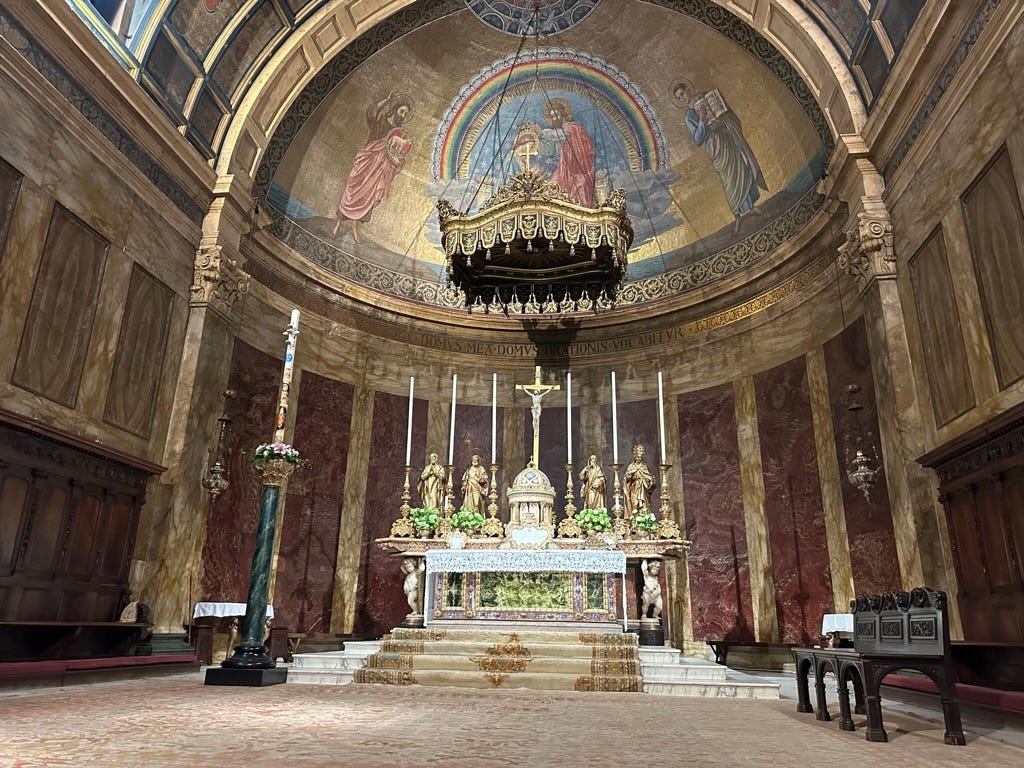
I have long admired St John Henry Cardinal Newman, having first encountered him in the halcyon idyl of my Anglican youth, not yet realising I would one day traverse a similar road down which Newman once ventured. I heard, some years ago, a talk given upon the occasion of his canonisation titled simply “Newman the Failure”. Herein was explored, with real and genuine tenderness, how a man who gave his entire life to the Church and to the patient labour of scholarship remained, until the end of it, riddled with doubt, with a persistent sense of his own inadequacy, and with a number of genuine failures, ventures that did not succeed, ambitions that did not resolve as he had hoped. I did not fully understand, when I first heard that lecture, why it moved me as deeply as it did. I understand now. I do not offer you, in the sea of words and memories that follow, the testament of a man who has arrived anywhere. I offer you the honest accounting of a man in the middle of his own unfinished argument with himself, who has decided, at long last, that the argument is worth conducting in full view rather than in the carefully curated privacy he had maintained for most of his life. Newman famously called his own such accounting an apologia, a defence, though I think anyone who has actually read him understands the word hugely undersells what he was really doing. He was not building a case for a jury. He was guiding us through every book, every conversation, every interior grapple, every private crisis that had moved him, by increments entirely too small to notice at the time, from where he began to where he needed to be, trusting that the walk itself would explain more than any verdict could. I did not purposefully set out, when I began writing this, to follow Newman’s example. I find, however, arriving now near its end, that I have unwittingly followed it anyway, which I take to be less a mark of my own originality than of how honestly any life examined closely enough tends to organise itself.
. . .
. . .
What follows, then, is not a case I am submitting for your approval. What follows is my attempt at that very language I have spent so long searching for in vain. It concerns the God who knew me before I was formed. It concerns Blood, and the particular inheritance of having been born to a people I know I love without qualification yet have, on more than one occasion, been told I do not love enough. It concerns the slow and largely undramatic process by which a man’s convictions, having been kept under careful wraps primarily for the comfort of those in rooms in which he wished to remain welcome, at last outgrew the wrapping. It is a stocktaking, the kind a man permits himself only when enough has happened, and enough has been lost, that polite pretence no longer feels survivable.
. . .
I have tried to present all of this as one continuous act rather than as argument followed by confession, because I no longer believe the two can be honestly separated, and because the people for whom I write this, whoever you turn out to be, have earned better of me than a case prosecuted from atop a podium. You have earned the truth, offered deliberately, the way one offers anything that has taken a lifetime to curate and interpret and that one is, even now, more than a little worried to say aloud.
. . .
I shall endeavour, as honestly as reticence may allow, to guide you through all the places and people and moments and years that have produced the marvellously complex soul now standing before you. I have often wondered what single thing accounts for all that, the morass of me. I have come to suspect there isn’t one. There is simply the residual accumulation: a parish discovered by accident, a mentor who taught me the utter joy of not taking the world quite so seriously, philosophers dead two centuries and contemporaries very much alive, a kinsman’s quiet courage, a country that moved whilst I was busy standing still, and two extraordinary women, now gone, but, even now, still listening, watching, waiting, praying.
. . .
Into my room these women come and go, chatting about Michelangelo…
. . .
Alright. Deep breath. Let us begin.
. . .
i. the pretzel
. . .
We begin, then, as the two of them would have wanted me to begin: honestly, and without the performative throat-clearing I have spent so long substituting for honesty. For most of my adult years, when asked where I stood politically, I gave an answer I had built the way a man builds a bridge over water he does not trust himself to cross, that is to say carefully, with redundancies, engineered to bear weight from more than one direction at once. I am, I would say, a left-leaning, pro-life moderate. This rather awkward appellation had the virtue of being technically true yet the far greater virtue of being almost impossible to pin down. It committed me to nothing a room full of people with conflicting politics could object to all at once. It let me keep my seat at every table, which is precisely what I wanted, and precisely what, I have now come to believe, no honest man ever should spend time wanting.
. . .
I will tell you what that phrase was actually doing because I think the diplomatic passport I carried for the better part of three decades is a more honest starting point than any of the views I now hold outright. A label, I have come to learn, is rarely a description. More often it is a wardrobe choice, assembled for the room one expects to enter, and I had, by the time I was old enough to vote, become rather adept at dressing for the room.
. . .
This is not, I want to be clear, a conversion story of the secular kind. I have come to distrust conversion stories of that sort, my own especially, because they tend to flatter the convert. They suggest a man who once believed one thing and now, having beheld some sudden light, believes another. They invite the reader to admire the seeing rather than to ask what, precisely, kept him from looking in the first place. What follows here is not that. The convictions to which this essay seeks to give context were not handed to me whilst en route to Damascus. They were, most of them, already present in me decades ago, inconveniently, the way a draught sits within a house no one has gotten round to insulating. What changed was not the belief. What changed was my willingness to stop pretending the draught wasn’t there, to stop telling guests it was merely the weather.
. . .
I can, in fact, date the draught’s first real gust with some precision, and I shall share the date because I think it matters. I was 15 years of age, a high school junior, and had been made editor-in-chief of my school’s student-led newspaper, a role generally reserved for seniors, in the autumn of 1997. Affirmative action was very much in the public conversation and consciousness that year owing, in part, to the enactment of California’s much-debated Proposition 209 as well as the U.S. Supreme Court’s earlier refusal to take up Hopwood v. Texas, in which the Fifth Circuit had previously determined the University of Texas School of Law’s use of race in admissions decisions to be unconstitutional.
. . .
In response, and with the blessing of our faculty advisor, I authored an editorial arguing, plainly and without hedging, that so-called affirmative action as policy was fundamentally insulting to Black people, that the implication underneath – that we required a lowered bar, a widened doorframe, a shortened fence, in order to compete – was itself a pernicious form of contempt masquerading as compassion. I do not think that I had read a single conservative text or analysis when I wrote it. I didn’t need to. I simply had to look at my own life, at the mother and grandmother who had made education and the pursuit of excellence the sole non-negotiables in a family that did not have very many other luxuries to spare, at cousins raised with the same unbending expectation, all of us told, repeatedly, that we represented not only ourselves but our entire family’s name and honour. And I just could not square that inheritance with a policy that asserted that people who looked like me required the rules be softened and the standards lowered in order to survive contact with people who did not. Whether that instinct can be proven statistically remains a genuine and unresolved dispute among economists and legal scholars; Richard Sander’s so-called “mismatch” research, which purports to show that beneficiaries of race-based admissions preferences are set up to struggle rather than to thrive at institutions for which their preparation did not yet suit them, has been challenged, revised, and re-litigated in the academic literature for nigh on two decades now, and I will not pretend the matter is settled, because it is not. But the argument itself is not fringe thinking. It is a real and serious open question, not a crank’s theory, and I did not need a peer-reviewed analysis in order to feel the awful weight of it at fifteen.
. . .
The recoil in response to my editorial was immediate and it was ferocious and it came from precisely the direction I had not expected. Members of the Black Student Union, a club whose weekly lunch period meetings I had attended, however infrequently, denounced the piece and, by extension, me, with a swiftness that startled my teenaged self considerably more than any disagreement from outside our community ever could have. For them, my traitorous rejection of this fundamental tenet of Blackness was little more than confirmation of Zora Neale’s belief that “all skinfolk ain’t kinfolk”. I would like to pause here for just the briefest moment because I believe this marks the single earliest data point, if you will, for everything this essay goes on to argue and explore. You see, I had not yet formed the pretzel described above. I did not yet know I would need one. What I learned, in that first and rather brutal instance, is that saying the true thing plainly, the first time, cost me something immediate and something communal, something very much tied to my sense of self and identity, and that the cost was not abstract. It was the sudden, cold withdrawal of people who had, until the previous week, been my friends, my kin. The pretzel I would spend the ensuing two decades quietly forming and living within was not built from confusion about what I believed or any loathing of who I was. It was built, quite methodically, as insulation against a version of that particular winter recurring.
. . .
I will be honest about how long this went on, as the honesty is rather the point. I registered to vote as a Democrat the way most of us inherit our first politics or receive our first cars, not through investigation but through bestowal; it was the family weather, the assumption already standing in the room, and I no more thought to interrogate it than I thought to interrogate the assumption that we attended church on Sundays or that education came before nearly everything else, regardless of what else we had or lacked. My first vote, cast in a presidential primary not long after I came of age, went to Bill Bradley, the more progressive of the two men seeking the Democratic nomination that year. I voted for him because the things he said sounded, to a young man’s ear, like decency, and decency, at that age, was nearly the whole of my political philosophy. Shortly afterward, for reasons I could not have fully articulated then and can only partially articulate now, I re-registered as unaffiliated. I told myself this reflected independence of mind. In truth, I think it reflected the first faint hint of the draught, a visceral discomfort for which I had not yet the vocabulary, or the wisdom, to name.
. . .
I stayed there, technically undeclared and independent, for the better part of two and a half decades, while underneath the technicality something else entirely was taking shape. I held convictions, in those years, on the unborn, on the family, on the relationship between faith and public life, on the difference between equality of dignity and equality of outcome, that, if we are honest, were never truly of the left, however carefully I dressed them up for company. I simply did not say so. Not plainly. Not for years. Not after that adolescent editorial taught me what plain speech, however keenly felt, could cost in reality. I told myself I was a committed moderate. I was simply undecided. Yet, I was not undecided. I was undeclared, and the difference betwixt those two states of mind is a gulf of considerable size.
. . .
Here, then, is the actual chronology, stated as plainly as I am now able to state anything. I registered as a Democrat at seventeen, mere months before the 2000 primary, California law permitting registration at that age when the next election fell within a particular window of one’s eighteenth birthday. I cast my first vote for Bill Bradley, the “liberal lion.” I re-registered independent not long after and remained so for nearly thirty years, a period in which I voted for Barack Obama twice, the second time with no less enthusiasm than the first; for Hillary Clinton, with rather less enthusiasm, but still for her nonetheless; and for Joe Biden in 2020. And then, the levees finally broke, and suddenly, I needed new, dry land upon which to exist. So, I voted for Donald Trump in 2024, not as a protest, not out of anger, not as the “lesser of two evils” but as a choice, a happy choice, having watched across the years between conservative conviction and the people who held it treated in public discourse not merely as mistaken but as something more akin to subhuman, a development I could no longer in conscience pretend I had not noticed. Early in 2026, having spent most of my adult life as a man who declared no party at all, I became, for the first time, a registered Republican. (You see, dear Jonathan, I can keep my promises.)
. . .
I do not offer that chronology as a tidy arc, because a tidy arc it most definitely is not, and I have come to appreciate the untidiness is the most honest thing about it. This is not the record of a man steadily migrating from one shore to the next. This is the honest record of a man whose convictions held remarkably steady while the ground beneath him, the party he had inherited, the rooms in which he had once felt safe, moved, decisively and at speed, in a direction he found he could no longer follow. I did not leave the Left so much as discover, slowly and then all at once, that it had already left certain values and convictions I was never willing or able to surrender.
. . .
What you are reading, therefore, dear friend, is no confession of error. It is something nearer an anagnorisis, a recognition, long deferred, of what was always the case. I am forty-four years old. I am done, at last, with the pretzel. What follows here is the rest of me: newly untwisted, unpasteurised, offered without apology and, one hopes, without disdain for those who will read it and disagree, because disagreement, honestly met, has never once deterred me. Only the silence did. I have given that silence enough of my life. Too much. It is now someone else’s turn to listen.
. . .
continue to movements ii & iii
. . .