

a brief note on publication
Sinfonia Apologia continues today with its second instalment: movements ii & iii, ‘on the plantation’ and ‘inheritance’.
If you are joining us only now, dear friend, a brief note to orient you. As a whole, this essay runs to some twenty-three thousand words, arranged as seven movements bookended by a prologue and an epilogue. I am publishing it as a serial precisely because so much of what it asks of a reader deserves to be sat with rather than consumed in a single sitting. The prologue & first movement were published just days ago; I would ask you, before proceeding here, to begin there, instead. As with a symphony, this really only makes sense upon hearing the first notes.
For those of you returning, thank you for accompanying me on this journey and for whatever quiet reflection you have already given these words so far. What follows now takes up where we left off. Nota bene: It asks a little more of you than did the beginning. Yet, as you will see, your patience shall be amply rewarded.
The serial concludes on Saturday, the twenty-second of August. Please, as before, read each portion as it comes, and allow it settle before the next one arrives.
Welcome back, friend. It’s good to have you here.
-Anthony McAlister
. . .
movements
prologue
i. the pretzel
ii. on the plantation
iii. inheritance
iv. kinship
v. on sovereignty
vi. roots
vii. the argument
viii. reckoning
epilogue
. . .
ii. on the plantation
. . .
Still with me? Good. Because there is so much more to say.
. . .
On the twentieth of August 2021, the Los Angeles Times published a column, penned by one vituperative Erika D. Smith, a Black woman, under the following headline: “Larry Elder is the Black face of White Supremacy. You’ve been warned.” That headline, despite the righteous furore it fomented, stands to this day: unaltered, uncorrected, and unapologised for. I want to keep it in view as we proceed, because everything I shall lay before you in this movement is, in one way or another, a gloss upon it.
. . .
There is a word that has been hurled at my feet, and at the feet of people who look and think like me, with a frequency and a casualness that I find, even now, remarkable. It is not a word I shall avoid in these pages, because avoiding it would be its own kind of dishonesty, and, as I have already promised to you, I am done with all that. The word is ‘sellout’, and it travels in company: ‘Uncle Tom’, ‘race traitor’, ‘Oreo’, ‘house nigga’, and on, and on, and on. I have been called more than one of these things, sometimes to my face, quite often behind my back, in places I was not meant to know about, and sometimes even by people who presented themselves, in the very same breath, as my putative allies. I want to examine that word carefully, because I think it contains, if you press upon it just hard enough, the whole of what it is I wish to say here now.
. . .
To call a Black man of a particular outlook, bearing, temperament, and worldview a ‘sellout’ is to make a categorical claim about what Blackness requires of him. It is to say that there exists a set of political positions, of cultural attitudes, and of social allegiances that are not merely the common, shared milieu of Black folk but mandatory, and that to deviate from them is not to exercise one’s freedom, intellectual or otherwise, but to betray one’s people, and in so doing, one’s very Blackness. It is, in other words, to insist that Black Americans are not individuals possessed of our own minds and our own moral agency, but rather members of an unwieldy monolith whose worth is conditioned upon ideological compliance. We must be very precise about this, because precision matters here more than rhetoric: that insistence, wherever it originates and however it is dressed up, is racism. Not racism-adjacent. Not racism of a complicated or contextual kind. Racism, full fat and raw. Racism, by any honest definition of the word, which has always meant, at its very core, the reduction of a person to their racial category and the presumption that the category then determines what the person is permitted to think, to feel, to become.
. . .
What makes this particular strain of racism so especially corrosive is its source. It does not come, in the main, from, ahem, the usual suspects. It comes, with a consistency I have spent decades observing quite closely, from the political Left. It comes most especially from White so-called progressives, who have cultivated, with apparent sincerity and seemingly blissful ignorance, a form of racial paternalism so thoroughly embedded in their assumptions about Black identity that it has become invisible to them, like furniture so long in place one has ceased to notice it is there.
. . .
This is not a merely impressionistic observation, and I want to be clear about that before proceeding, because a claim of this kind, made by a Black conservative, will be received in certain quarters as self-serving complaint rather than honest analysis. So, permit me to lay the evidence before you before I state the argument.
. . .
In 2019, psychologists Cydney Dupree of Yale and Susan Fiske of Princeton published findings, drawn from five controlled experiments involving more than two thousand White participants, that White liberals systematically presented themselves as less competent when addressing or interacting with Black people than with White people. Democratic presidential candidates, the archival portion of the study found, used markedly less competence-related language when addressing minority audiences than White ones. Republican candidates, by contrast, showed no such shift. The authors described this as a form of patronising behaviour, an attempt to appear warm and approachable by implicitly calibrating downward to what the speaker assumes its Black audience are equipped to receive.
. . .
It is, in the language of a Republican president addressing the NAACP in the summer of 2000, “the soft bigotry of low expectations.” That phrase was coined by George W. Bush’s speechwriter, Michael Gerson, and has since been taken up with characteristic force by the economist Glenn Loury: “Don’t patronise my people. Don’t inflict on us the consequences of a soft bigotry of low expectations. Don’t presume that we’re not capable of objectively expressing excellence in the same way as any other people are expressing excellence.” I cite a Republican president and a Black economist in the same breath here purposefully, because the argument they are both making is not, in any sense, a partisan one. It is a human one.
. . .
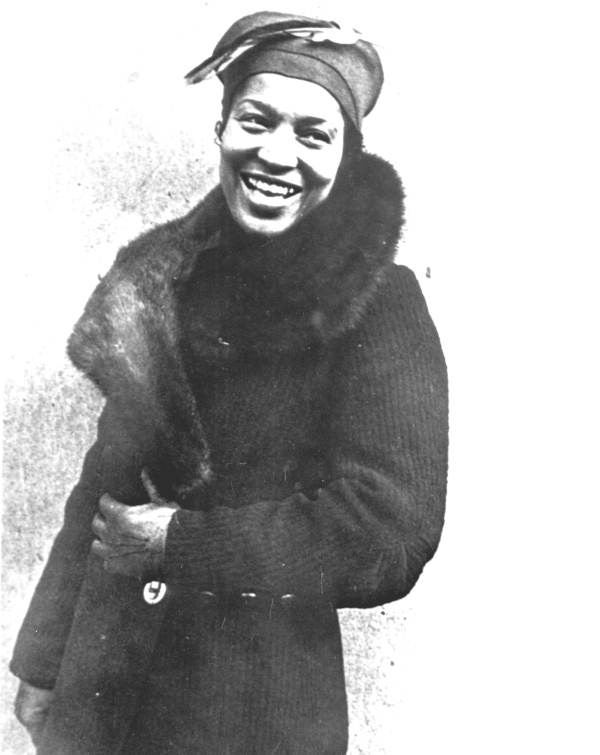
It is also, it should be said, not a new one. Zora Neale Hurston, one of the great literary figures of the twentieth century, and a woman whose politics defied easy categorisation, opposed the Brown v. Board of Education decision in 1955 on precisely these grounds, arguing in a letter to the Orlando Sentinel that court-ordered integration told Black Americans, in effect, that their own schools and communities were something to be fled rather than built and improved. “How much satisfaction can I get,” she wrote, “from a court order for somebody to associate with me who does not wish me near them?” While the White liberal reformers celebrated the decision, Hurston, and many others like her, understood exactly what it implied about the assumptions underneath it.
. . .
. . .
Malcolm X understood it, too, and said so rather more forcefully, as was famously his wont. In October 1963, speaking at the University of California, Berkeley, he drew a distinction that I have found, in the sixty-odd years since the words were spoken, to be among the most clarifying formulations in American political thought. Speaking of White conservatives, Malcolm allowed that they were not friends to Black Americans, but argued that they possessed at least one quality the liberal did not: they let you know where you stood. The ‘southern wolf’, he called them, open, undisguised, predictable in their hostility. The northern liberal, by contrast, was something else entirely: the fox. The one who posed as your friend. The one who, in Malcolm’s own words, was “even more cruel and more vicious” than the wolf, because the cruelty was disguised as concern. “These northern foxes pose as White liberals,” he said.
. . .
I cite Malcolm X here advisedly. I am aware that his name, in certain quarters, functions as an alarm, a signal that whatever argument is being made has ventured somewhere uncomfortable. Good. It should be uncomfortable. Because the argument he made in 1963 is, in its essential structure, the argument I am making now, and the fact that a Black Muslim separatist and a Black Catholic conservative have arrived, across sixty years and from entirely different directions, at substantially the same conclusion about White liberal paternalism, ought at minimum to give a thoughtful reader pause. The framework now in place, let us return to the evidence.
. . .
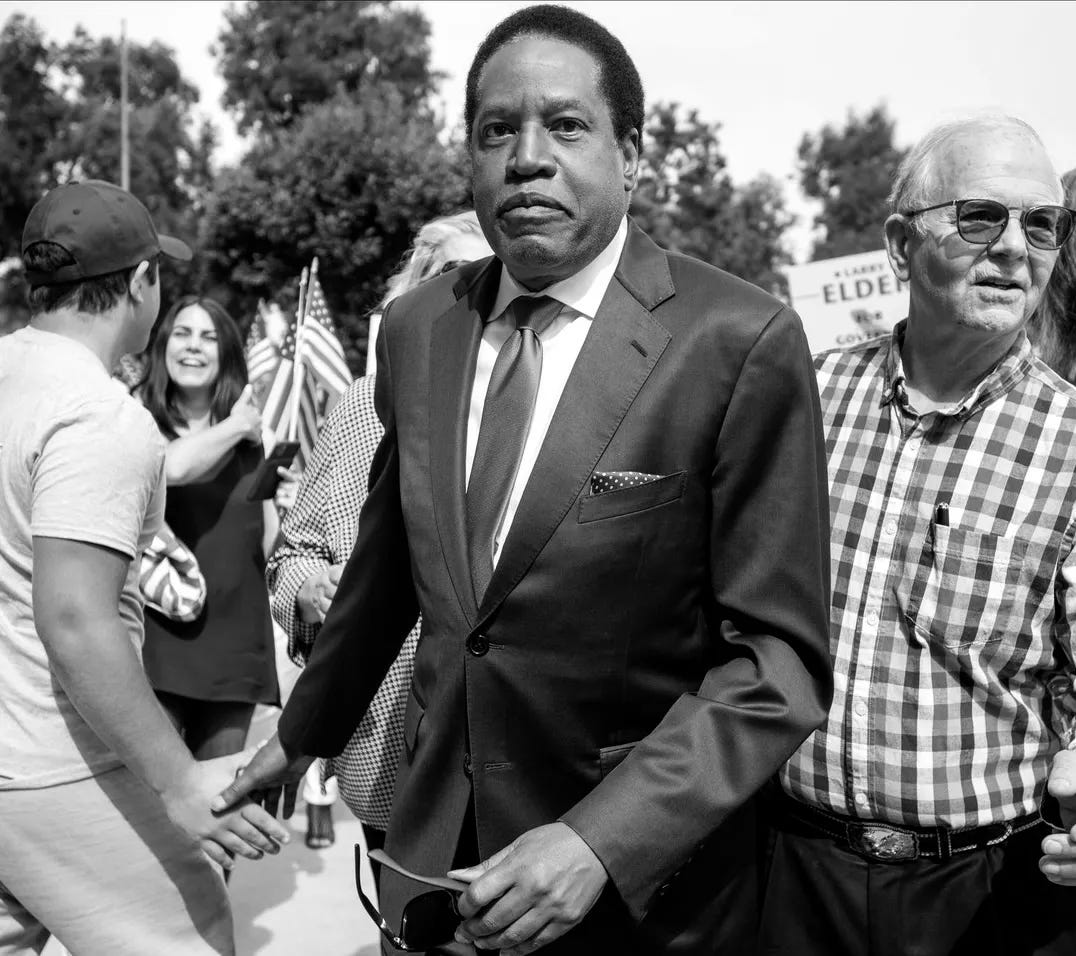
The full story of what was done to Larry Elder in the summer of 2021 begins, as I said, with that Los Angeles Times editorial. Oh, would that it had stayed there. On the eighth of September, five days before the California gubernatorial recall election, Elder, a prominent and outspoken Black conservative lawyer and media figure, was touring homeless encampments in the Venice neighbourhood of Los Angeles (not as salubrious as it may sound). He moved through the crowd, speaking to the press, conducting himself as candidates do. A White woman on a bicycle, wearing a gorilla mask, rode alongside him before deciding to throw an egg at him. Someone else in the crowd shouted, almost as if on cue, and I am quoting directly: “Get that sellout piece of shit out of here.”
. . .
I would like for you to sit with that, for a spell. A White woman. In a gorilla mask. Hurling an egg at a Black man. In Los Angeles. In 2021. On camera. All whilst another voice shouts racial abuse. If the races concerned were reversed, we would not need to imagine the breathless press coverage nor the outcry. We know what it would have looked like. We know because we have seen it. What we beheld on this occasion, instead, was near total silence: a story that did not fit the narrative, filed quietly, noted briefly, and briskly moved past. No arrest was made. No charges were filed. The very people who have spent years insisting that so-called hate crimes are the worst imaginable ills humans can visit upon each other, and who demand federal investigation and uniform denunciation of the same, somehow found, in this instance, that their attention was required elsewhere.
. . .
I wrote about this at the time, in a private piece circulated among friends and colleagues, at the end of which I identified myself, pointedly, as a progressively-minded, pro-life moderate. I mention that self-description yet again because I want you to see it for what it was: the pretzel, in writing, dated and preserved, still constraining me even as I was in the act of angrily chewing through it. I was angry enough to name what had been done to Larry Elder as racist, yet not quite free enough to name what that made me. That freedom was still many years away.
. . .
. . .
The second case before us is that of Winsome Sears. In November 2021, Sears was elected Lieutenant Governor of the Commonwealth of Virginia, the first Black woman ever elected to statewide office in the history of the Old Dominion. For a political culture that has expended considerable energy in recent years in the celebration of “firsts” in which the word “historic” is deployed with a frequency that has begun to erode its meaning, this was a first of genuine, substantial, and unambiguous historical significance. A Black woman, an immigrant, a veteran of the United States Marine Corps, a self-made businesswoman, elected to high constitutional office by the voters of a state whose history of race relations is among the most freighted in the nation.
. . .
You might have expected, had the celebration of Black women’s achievements been as sincere and intentional as its most vocal proponents claim, at least some acknowledgment of that rather extraordinary first. You would have waited in vain. The silence from the progressive Left was not merely noticeable, it was pointed. Because Winsome Sears, it turns out, was a Republican. Gasp! And a Republican first, under the current political exchange rate, does not really count as a first at all.
. . .
The third case before us requires somewhat more careful handling, because it involves a sequence of events separated by nearly two decades, and because the bitter irony at its core is of the kind that, stated plainly, requires no rhetorical embellishment whatsoever.
. . .
Janice Rogers Brown was an Associate Justice of the California Supreme Court, and one of the most intellectually formidable jurists of her generation. In the summer of 2005, Justice Sandra Day O’Connor announced her retirement from the United States Supreme Court. President George W. Bush was bound to nominate her replacement, and Justice Brown was among those seriously considered for the seat, reportedly earning a spot on the short list. She was, it must be noted, a Black woman.
. . .


. . .
And she did not receive the nomination. What she received, instead, was a clear and unambiguous rebuke from Senate Democrats, conveyed most forcefully by one Joseph R. Biden of Delaware, then the ranking minority member of the Senate Judiciary Committee, that her nomination would face, in Biden’s own words, delivered on CBS’ Face the Nation in July 2005, a “very, very, very difficult fight.” The objection was not, he claimed, to her race. The objection was to her judicial philosophy, which was unabashedly conservative, and which was, therefore, in the estimation of the Committee’s ambitious senior Democrat, disqualifying. President Bush, yielding to pressure and political calculation, ultimately nominated appeals court judge Samuel Alito, who was duly confirmed. Samuel Alito. A White man.
. . .
Seventeen years later, in September 2020, President Biden, now occupying the White House rather than a Senate committee seat, proudly and unironically declared his intention to nominate the first Black woman to the United States Supreme Court, upon the vacancy created by the death of Justice Ruth Bader Ginsburg. He made of this announcement a considerable occasion, speaking at length of its historic weight, of how long it had been in coming, of what it would mean for the country. He nominated appeals court judge Ketanji Brown Jackson, a jurist of genuine distinction, who was, in time, confirmed, thus becoming the first Black woman ever to serve on the U. S. Supreme Court.
. . .
I watched this unfold with a feeling I can only describe as a very particular species of bitterness, the kind that arrives not from anger alone but from the combination of anger and clarity. Why? Because I remembered 2005. I remembered who had been there, and what had been said, what had been done, and what it had meant. The man who stood before the country in 2022 celebrating the historic appointment of a Black woman to the Supreme Court was the very same man who had made it unmistakably clear, seventeen years prior, that a Black woman’s presence on that Court was only welcome if she thought the right thoughts and espoused the right politics. Janice Rogers Brown was indeed a Black woman. Her problem, however, was that she was the wrong kind of Black.
. . .
I have shared this sequence of events with friends, many of whom were unaware of it or had allowed themselves to forget. The usual reaction, with a regularity I have come to expect, is silence. Not the silence of agreement. The silence of those who have encountered an uncomfortable truth they do not know how to address, and who have decided, for the time being, to do nothing with it. I understand that silence. I lived inside a version of it for most of my adult life. But I am no longer willing to pretend it is Swiss neutrality. Silence, in the face of a racial hypocrisy this astonishingly glaring, is itself a position.
. . .
I said at the outset of this movement that that particularly execrable Los Angeles Times opinion piece impelled, in compressed form, everything I have been moved to say here. Let me now say it in expanded form, as plainly as I know how: the so-called progressive Left have, over the course of several decades, constructed an understanding of Black Americans not as a people of infinite variety, complexity, and individuation, but as a constituency, a cause, and, when necessary, a mirror in which White liberal virtue may be admired. Within that construction, a Black man who resists his assigned role is not merely a political opponent. Oh, no. He is far worse. He is a category error, a malformation the system has no framework to accommodate, and to which it must therefore respond with the only tools available to it: delegitimisation, mockery, dismissal, denigration, and the particular cruelty of being told, by people who simultaneously claim to love him, that the way he has chosen to live and think and believe and order his very life is proof that he does not love himself. And that, dear friends, is more painful to me than the sight of a cross burning on the front lawn.
. . .
I am utterly convinced that there is nothing more offensive to a White liberal than the existence of a Black conservative. Not because the White liberal is consciously malicious, though some are. But because the Black conservative violates, simply by existing and declining to perform the expected minstrel contrition, the entire architecture of the White liberal’s self-understanding. The White liberal needs Black suffering to be legible, manageable, and politically addressable, because the White liberal has built an identity around being the one, the only one, who can address it. A Black man who says he does not need that address, who says his politics are his own and his mind is his own and his dignity requires no external validation, is not merely an inconvenience. He is an affront. He is proof that the entire project was never quite as selfless, as virtuous as we were given to believe.
. . .
I know this not only from reading but from living. I know it from the conversations that were not permitted when the wrong people were in the room. I know it from the friends who went quiet when I spoke certain words in their presence. I know it from the names I was called, as a child and as a man, not by people who disliked me but by people who believed they were on my side, and who found my independence of mind, my choices of friend and partner and music and politics and faith and speech, to be a kind of betrayal of an agreement I had never signed.
. . .
The plantation, in this formulation, is not an historical metaphor. It is a current operating condition. And the price of leaving it, as I can well attest from lived experience, is paid in relationships, in rooms one is no longer welcome to enter, in the peculiar loneliness of the person who has been informed, with great warmth and absolute certainty, that the way he has chosen to live is evidence that he does not know his people or love himself.
. . .
I know my people. And I know that we are more than a mere cause, a voting bloc, a hapless child needing to be saved and protected and gently handled.
. . .
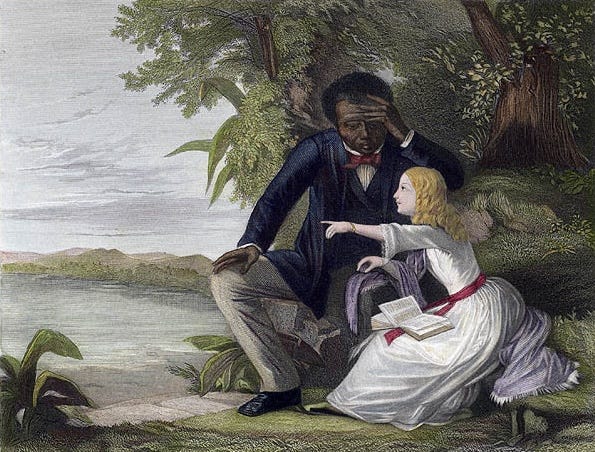
Uncle Tom was the hero, by the way. Perhaps next time, Miss Smith, try reading the fucking book.
. . .
. . .
iii. inheritance
. . .
There is a question I have been asked, in various forms and with varying degrees of bemusement, at periodic points throughout my adult life, and it is this: how did I get here? Not merely how did I arrive at this particular worldview, but how did a Black man, born and raised in Southern California, the son and grandson of women whose faith and sacrifices were the whole of his early world, shaped by a community that has, for generations, believed the Republican Party and its ideological allies to be its natural adversary, come to arrive at the convictions set forth in this manifesto of belief? The question is sometimes asked with genuine curiosity. More often, however, it is asked with the implicit assumption that the answer must involve some deficiency, some wound, some failure of racial solidarity that produced, as its melancholy issue, a man who, as we have said before, thinks the wrong thoughts.
. . .
I want to answer that question honestly, and honesty requires me to begin somewhere the reader likely will not expect: not with politics, and not even with philosophy, but with a half-page of small print in a Saturday newspaper.
. . .
I was about fifteen when I was grudgingly granted leave by my poor, exasperated mother to stop attending the church of my boyhood: an historic, large, and politically influential congregation, whose worship I had once loved and had, by then, come to find hollow in some way I could not yet articulate, glossy where I wanted substance, loud where I craved quiet. My mother, after a standoff that lasted rather longer than either of us expected, gave me a choice with no third option: find another church to attend, or return to hers. I do not think she anticipated where that choice would lead either of us. I certainly did not.
. . .
The Los Angeles Times, in those years, still printed a religious directory each Saturday, a dense, partial, alphabetical listing of the city’s churches, synagogues, and temples, and I went looking through it the way a bored and curious teenager goes looking through anything, without much of a plan. Near the very top of the list, under A, sat a single word that snagged something in my memory: Anglican. I had absorbed, from the comically anti-Catholic textbooks of the small Pentecostal parochial school I attended from kindergarten to grade eight, published by a Florida house that could not resist working some polemic against Rome into even a mathematics lesson, a child’s cartoon of what Anglicans were: Catholics, more or less, but reformed, corrected, relieved of the Pope and the statues and the excessive devotion to Mary, Catholicism with the difficult bits conveniently excised. I was, even then, the sort of child who heard a categorical prohibition as an invitation to explore, who went looking for the door it was nailed shut over. I needed to see for myself, to understand, through my own experience, whether the thing I had been told was bad truly was. Yet, if I had suggested that I wished to attend a Catholic Mass and risk being corrupted by the very “whore of Babylon” herself, my dear Methodist mother, I reasoned, would have lowered the proverbial boom. So, to satisfy my curiosity yet prevent the likely reenactment of the Battle of the Boyne in our living room, I compromised and suggested the Anglicans instead.
. . .
. . .
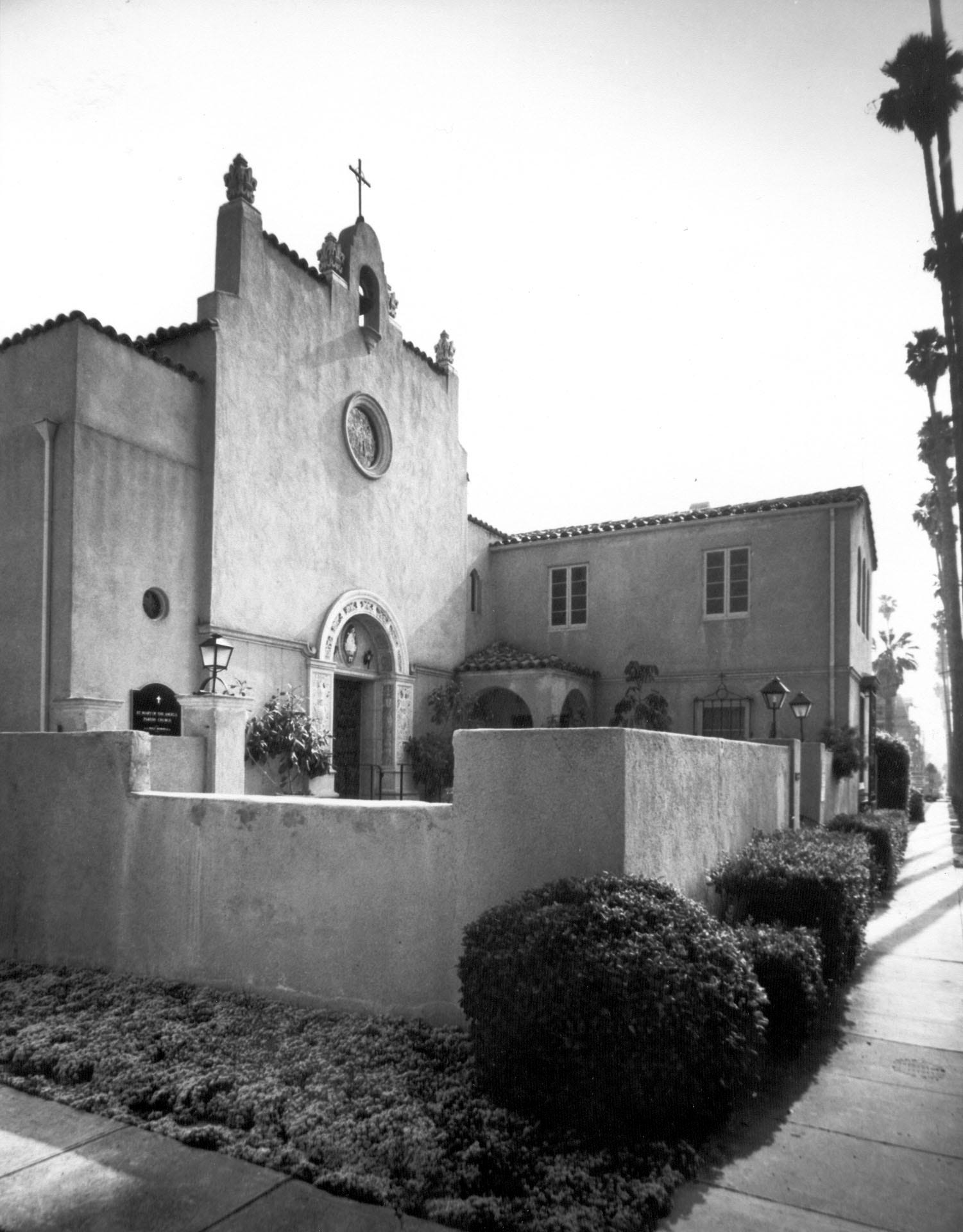
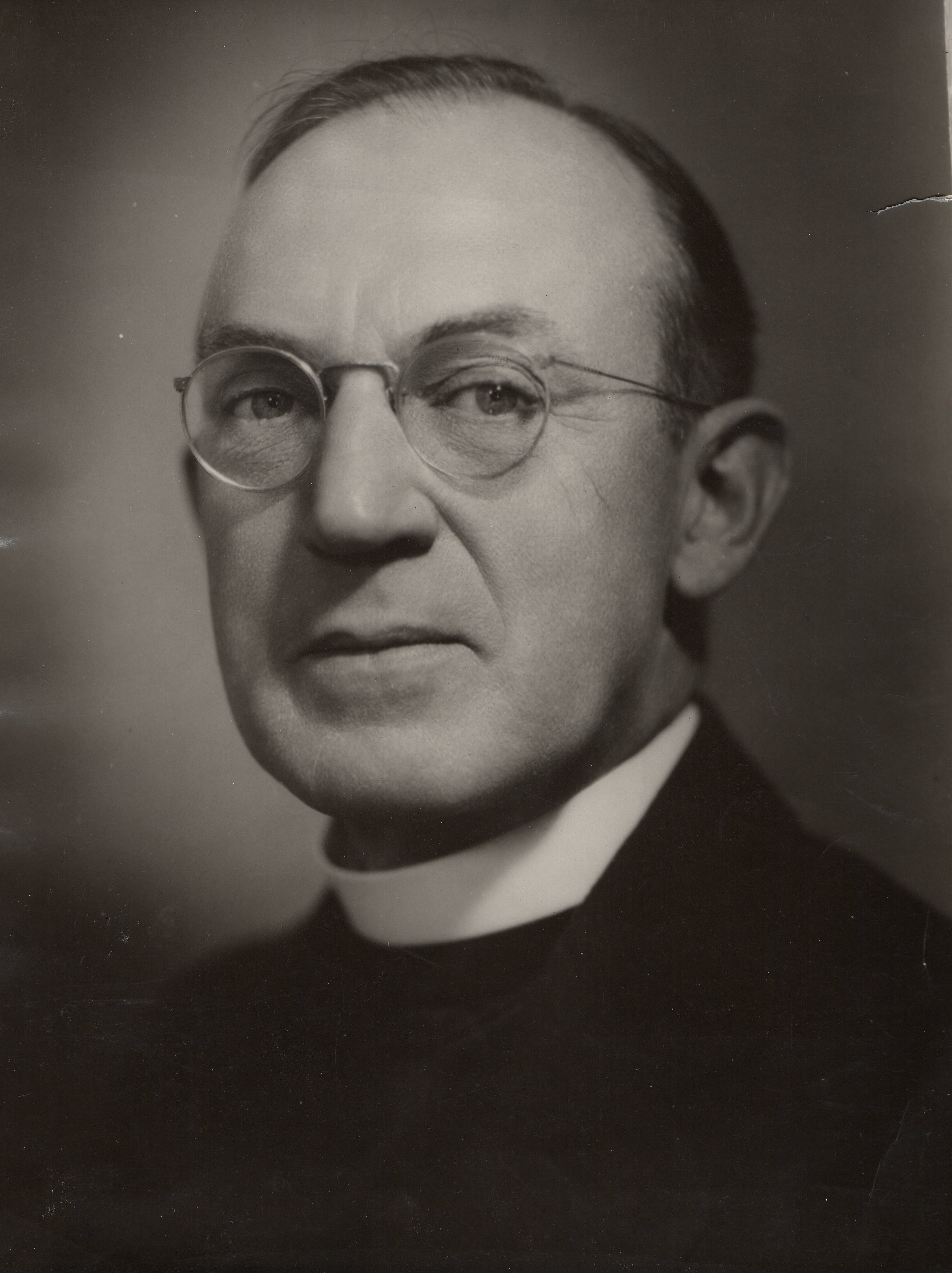
The church where I ultimately landed was St. Mary of the Angels, in the Los Feliz district, and I did not know, timorously creeping in on a Sunday morning in January, with my wary but willing mother close beside me, that I had wandered into a building with a history considerably more storied and complex than the word Anglican could suggest. It had been founded in 1918 by the Reverend Neal Isaac Dodd, a priest of the Episcopal Diocese of Los Angeles who also moonlit as a character actor, ultimately appearing in well over forty Hollywood films, always as a cleric.
. . .
. . .
Father Dodd would come to be known affectionately as “Hollywood’s Padre” owing not only to his film work but also his specific and deliberate ministry to his fellow actors. St Mary of the Angels, almost from its very founding, was known as the actors’ church thanks to the glittering roster of film stars and the like who made the parish their spiritual home. Many of its earliest and most generous patrons were drawn from the film colony’s first golden age. Mary Pickford and Douglas Fairbanks famously donated the initial capital required to purchase the land and build the building. “Fatty” Arbuckle and others were members, and MGM provided an orchestra for the church’s inaugural Mass.
. . .


. . .
And then, decades later, the relative Pax Anglicana enjoyed by St Mary’s and many other parishes like it would be dramatically upended when the Protestant Episcopal Church of the United States voted along highly divided lines at its General Convention of 1976, without the concurrence of Canterbury or of any other part of the wider global communion from which it claimed descent, to begin ordaining women to the sacramental priesthood, a decision that gravely violated the Church’s hitherto constant and unbroken understanding of Apostolic Succession shared by both Rome and Orthodoxy alike.
. . .
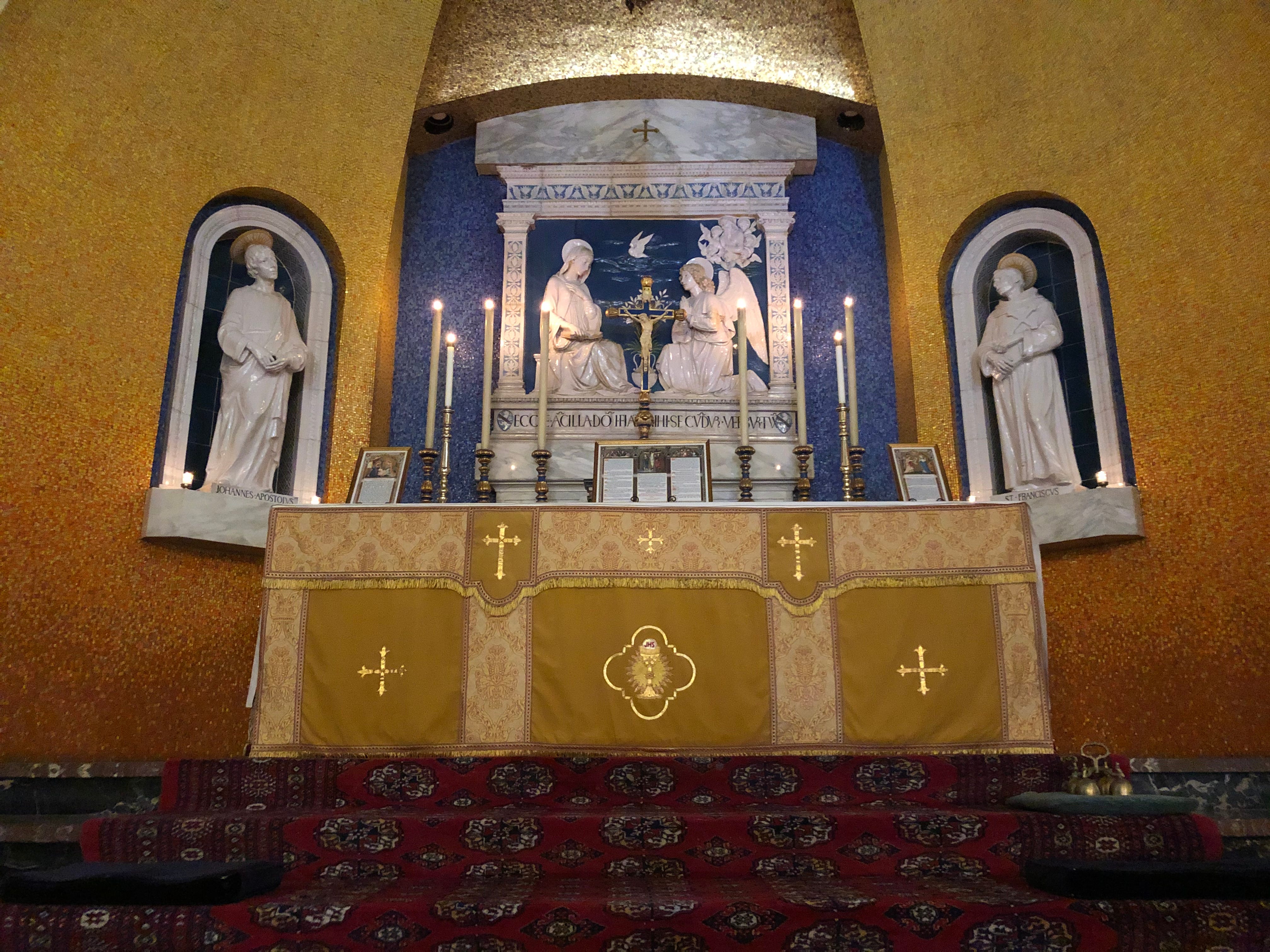
This breach touched upon a foundational tenet of Christian belief that many considered simply beyond any church’s authority to alter. St Mary’s was among them. She became one of only five parishes in the entire Los Angeles diocese to do what had, until that year, been all but unthinkable: secede from the now heterodox Episcopal Church, formally and permanently, choosing instead costly adherence to unbroken Church teaching over the socially and politically driven embrace of what she knew to be heresy. I knew none of this upon walking in that January morning. I knew only that the place, modest as its ornamentation actually was, hit me like weather. Decades of incense worked into the wood. Candlelight. The gentle click of shoes upon well-worn stone. A gallery of organ pipes, hidden, yet soon to announce themselves in startling fashion. Flowing vestments of brocaded silk. It was, without exaggeration, a feast for every sense I possessed, and I was absolutely undone by it before a single word of doctrine had been uttered to me. The day, I remember noting with not a small sense of exhilarated wonder, was Sunday in the Octave of the Epiphany. Whatever that meant.
. . .
I ached to return and to experience that again. After months of patient lobbying, my mother, less thoroughly persuaded, reluctantly agreed, and within a few months I had become, in the particular and total way only a serious teenager can become anything, a fixture of the place, then a student of it, then something closer to its ward. I read everything I could find: general church history, Vernon Staley’s extraordinary primer, sacramental theology, and, because curiosity proved overwhelming, the Catholic sources too: the Catechisms — Trent, Baltimore, and the 1997 edition, the documents of the Second Vatican Council, the encyclicals of popes whose names I was only then learning for the first time, the luminous and revelatory books of Archbishop Fulton Sheen. I remember early on one of the parish curates opening a small leather box at the conclusion of a confirmation class, a small box holding perhaps eight small, round, glass-topped cases, each containing some fragment I did not yet have the theology to interpret, a splinter of the True Cross among them, and feeling, before I understood what I was looking at, a jolt of something close to alarm because, we were shortly told, the contents of that little box called a reliquary were, well, the relics of various saints. Ye gods! These people, I remember thinking, are as bad as the papists I had been warned about. I kept coming back regardless. By the time the catechesis caught up with the instinct, I understood why the communion of saints mattered, why a faith that engaged the whole body – taste, smell, sound, posture, and not merely the intellect – was not superstition but a fuller and more honest account of what a human being actually is. I fell in love with the thing itself, not merely its atmosphere.
. . .
It was there that I was taken in hand by a man who would become, and remain until his death, the truest father I have ever known. Then-Subdeacon Eugene “Beau” Davis was, by the time I met him, on the edge of retirement from a remarkable career as a physician assistant, one of the earliest ever licensed to practice in the state of California. This work had followed previous turns as an Army intelligence officer in Cold War Germany and years as a paramedic in the crude, improvisational infancy of what would come to be known as the emergency medical services, and had led, near its end, to caring for patients at AIDS healthcare charities in those early years of the AIDS pandemic when such work required something of a person’s courage as much as their competence. During his eventual path towards ordination to the diaconate and then ultimately the priesthood, he was the very beating heart of St. Mary’s liturgical life, serving as its Master of Ceremonies and as the trainer of the parish’s altar servers, known as acolytes. It was in this context that our relationship, as stripling to sagacious elder, sapling to weathered oak, mentor to mentee, father to son, truly took root.
. . .

. . .
In teaching me how to serve at the altar, Beau not only taught me simply where to stand and when to kneel and why, but by explaining, patiently and at length, why the Church stood there at all, what each gesture had meant to the men and women who had first made it, centuries before either of us existed. He instilled in me not simply a love of liturgy because of its aesthetic appeal, but, like a piano teacher who teaches one not just the notes to play but the music theory behind them, through the careful and precise study of the liturgy, the Church’s ancient public prayer, he sketched for me an outline of the entire 2,000-year history of what is rightly every Christian’s patrimony and inheritance, even those who purposefully separate themselves from the Church that Christ Himself established. It was through Beau’s eyes and the filter of his considerable lived experience that I entered into and ultimately became lost in the world of Dearmer and Lamburn and Fortescue, of Donne and Neale and Newman, of Herbert and Laud and the Caroline Divines, of the glories of Gregorian chant and the utter horror of Anglican chant done poorly, of Nashdom and Mirfield, of Dom Gregory Dix and Lord Halifax, of Cranmer and Keble, of Tallis and Byrd and Merbecke, of the Cowley Fathers and the Anglican OSB, of Benediction of the Blessed Sacrament and the Tantum ergo, of the richness and pomp and splendour of the Solemn High Mass and the preternatural stillness of a Low Mass said with whispered reverence. This, all of this, was my treasure. It gave form and shape and meaning and depth to what, until then, had been a largely impoverished experience of faith and worship, having been cut off from the rich and nourishing taproot first watered by those drops of Divine sweat and blood that flowed from Golgotha to the Upper Room, to Ephesus and Galatia and Corinth, to Athens and Rome and Trent, to Canterbury and Los Feliz… How could I not – how could anyone so immersed in something so rich and beautiful and intricately woven – give myself over so utterly and have my world and my view of it so irretrievably altered? Lex orandi, lex credendi, indeed.
. . .
. . .
I want to tell you something about Father Davis that complicates any tidy story you might be inclined to construct from what follows, because he would have insisted on the complication himself, with considerable relish. He was, in his theology, entirely, unshakably orthodox, unbending on matters he considered non-negotiable, and rigorously, scientifically pro-life, a position he reached not merely through Scripture but through the plain physiological fact, known to him as a clinician as it was known to him as a believer, that what grows in a womb is not a philosophical abstraction, but a human life in progress. Yet he was, in his secular politics, about as far to the left as a man could comfortably stand, a fact he proclaimed himself, via a phrase I have never fully understood and have never stopped enjoying, by declaring himself “to the left of Attila the Hun”. He has been gone now some sixteen years, so I hope he will not mind me saying this now, although it was scarcely something he made any effort to hide when alive: Beau loathed Republicans, on principle – absolutely loathed them – and considered President George W. Bush an affliction of especial difficulty. He would have found a great deal of what follows in this essay, I suspect, either exasperating or hilarious, quite possibly both at once, and quite possibly in the same breath, and yet, he may well have found himself making the same latter-day confession as I have been laying out here. He also smoked like a chimney, drank weak Scotch with a connoisseur’s devotion, and could recite, from memory and with gusto, entire scenes and lines of dialogue from nearly every musical and classic film ever made and would often do so without warning. He remains, of every person I have ever known, the single best argument I possess that serious faith and serious engagement with the secular world can occupy the same capacious man without either apologising to the other. I present him here not as a loophole in my own argument but as a corrective to anyone tempted to see in this essay the suggestion that genuine belief points in only one political direction or philosophical worldview. It does not. It never has. I simply, in time, came to see the two threads of my own life, the theological and the political, pulling in a single direction, where his, for reasons that were entirely his own and that I fully respect, never quite did.
. . .
Early in my formation as an Anglican, I carried with me a set of specific and stubborn objections to the Church of Rome: her teaching on contraception, the authority claimed by the papacy, the honour paid to Mary. I did not resolve these objections through argument imposed upon me. Without actually intending to, I resolved them, one by one and over years, the only way I have ever resolved anything of genuine importance: by reading the thing itself, in its own language, rather than in the language and with the words of its critics, by taking the Catholic Church’s own catechesis seriously enough to let it answer the question on its own terms before I deemed the question unanswerable. And, to my own considerable surprise and mounting discomfiture, the objections simply stopped being objections. I found, one day, examining myself with the same honesty I have tried to bring to this entire work, that I no longer disagreed with anything the Catholic Church actually taught and believed.
. . .
While conversion would have been the logical and expected thing to follow, I did not convert immediately. St. Mary’s had become, by then, not merely my church but my home, and conversion meant risking friendships, affection, and love I simply could not fathom losing. I allowed that fear to cement my feet in place far longer than I am proud to admit. What finally moved me to wade into the Tiber and commence my lonely swim to the far shore was not an argument but a farewell that preceded a death, which in turn occasioned an election. In April 2005, I watched, along with the rest of the world, as Pope John Paul II sharply declined in health before finally passing away. I beheld these extraordinary scenes with a grief that surprised me in its depth, and, weeks later, newly unemployed and glued to my television, I watched as the ancient College of Cardinals elected Joseph Ratzinger, a man whose teaching and fearless orthodoxy I had for years admired, to assume the Chair of St. Peter. I let out a shout, I am told, of the sort usually reserved for a stadium. Beau, hospitalised that same week for an unrelated matter, was sporting an identical grin when I popped round to his hospital room later that day, and could speak of nothing else. Sitting with him, sharing an unguarded joy neither of us needed to explain to the other, I understood that I had run out of honest reasons to remain outside a church whose entire corpus of teaching and belief I had already, quietly, come to accept. To continue as I was would have been, at best, pretence, at worst, an affront to the very God whose patient shepherding and generous provision of grace led me to, at long last, know the fullness of faith first given to the Twelve and so valiantly and improbably safeguarded by the Church His Son Himself had built.
. . .


. . .
I was received into the Catholic Church on the sixth of June, 2005, the Feast of St. Norbert. I made a solemn profession of faith. I signed my name to the Athanasian Creed. I was enrolled in the Brown Scapular of Our Lady of Mount Carmel, blessed, and welcomed home. Present that day, in that simple, yet lovely Claretian chapel, were Mrs. Lemelle, the greatest teacher I have ever known, whose quiet, yet sincere practice of her Catholic faith planted seeds I was largely unaware of until they began sprouting; Father Touchstone, an Episcopal priest of a bygone era, whose friendship and mentorship I would enjoy until the end of his life; Bill, an extraordinary autodidact and an elder fellow acolyte from St. Mary’s, who, as a secretly practising Catholic, became for many a kind of Harriet Tubman, guiding many friends into the Catholic Church, discreetly, with neither gloating nor fanfare; Charles, who to this day remains a most cherished friend, whose charisma and charm I fell victim to when first we met years before, whose Chestertonian conviviality, whose erudition and scholarship in service of the Church made a considerable impression upon me, and who would later serve as my confirmation sponsor. And, of course, there was Mom, by now no longer wary, seeing the fruit that this different spiritual tree was producing in the life of her only son.
. . .
I tell you all of this not as a religious memoir wedged inside a political accounting, but because I do not think the rest of this story, this slow-rolling evolution, can be fully understood without it. Long before I ever encountered a page of Burke or de Maistre, I had already known, in the marrow of my very soul, the thing their philosophy would later give me language for: that Truth is something one receives, through inheritance and formation and the patient accumulation of a tribe’s hard-won wisdom, rather than something one invents from first principles in a single afternoon. I did not choose St. Mary’s or High Church Anglo-Catholicism because I had first worked out a theory of tradition and gone looking for an institution to embody it. I fell into a particular, unrepeatable place, shaped by a particular history of quiet resistance in the service of sacred tradition, and it formed in me, before I had any politics to speak of, a sense of what is owed to the past and what the past, rightly understood, still has to teach the present. Everything that here follows is an attempt to give that instinct its proper name.
. . .
. . .